Showing posts with label politics. Show all posts

Monday, February 28, 2011

'Health coaching': One application for the Health Care Domains Model?

The following message from Helen Erickson (Univ. of Texas) was received through the Modeling and Role Modeling mail list MRM-L at LISTS.UFL.EDU. It is the patient education aspect of the post that is of interest to me as it highlights why I continue to champion Hodges' model near and far.

'Coaching' (in its various forms) is a potential application for h2cm which can be used explicitly by explaining the model to the (potential!) patient / carer, or implicitly used by the health care professional as an aide memoire - a conceptual framework.

More to follow as I referred to the matter of health care delivery vs. health education in my presentation and the delegates raised the question of applications of Hodges' came up in Paipa last week.
<->

Good afternoon,

Some of you know that the healthcare bill signed last year (HR3590) includes a section aimed at revamping the healthcare system from a disease model to a health promotion, disease prevention. Section 4001 particularly addresses care for those on Medicaid and Medicare. A national advisory committee is being named to study this, make recommendations, etc (see Section 4001). Among the representatives of specific groups (orientation to health care) being named to the advisory group is the "health coach".

STTI and ICN put out a manual on coaching a year or so ago, coupled with a short CE test. When I read the manual and took the test (it took about 10 minutes total), I discounted the movement, thinking that it was just another way to define what we call MRM. The only difference is that it requires some specific strategies and skills, most of which I've discussed with you through the years, e.g. contracting, The other difference will be determined by what happens at the national scene. It is possible that "coaching" will be reimbursed. Many think that it will, thus the national group out of Harvard, the University of MN, and others are meeting, talking, defining the construct, etc.

As Chair of American Holistic Nurses' Certification Corporation, I have been drawn back to the topic repeatedly. Most recently, AHNCC has decided to actively explore certifying nurses who practice holistic health coaching, i.e.certifying a holistic health nurse coach. I have added a poll to the ahncc website, eager to learn if nurses are interested in the movement, etc. if you are interested in the website or want to express your position on health coaching, please visit ahncc.org.

Hope to hear from you,

Best to all,
Helen

Wednesday, February 9, 2011

OERU / OERF / UNESCO Press release: Towards an OER university - Free learning for all students worldwide

Please circulate: Joint OER Foundation / UNESCO press release.
The Open Education Resource (OER) Foundation is to host a strategic international meeting in Dunedin on 23 February, to commence planning for the provision of free learning to all students worldwide. Support from the United Nations Science and Education Organisation (UNESCO) to stream the meeting on the internet will allow the participation of education leaders and interested persons from around the globe.
Join the meeting as a virtual participant and help make OER futures happen.

Read more.


(If you blog about this important meeting -- please use the #OERU tag).

2011 will be a quantum shift year for the mainstream adoption of OER.

Cheers
Wayne
Wayne Mackintosh , Ph.D.
Director OER Foundation
Director, International Centre for Open Education,
Otago Polytechnic, New Zealand.
Founder and elected Community Council Member, Wikieducator
Skype: WGMNZ1
identi.ca

You received this message because you are subscribed to the Google Groups "OER university" group.
For more options, visit this group at
http://groups.google.com/group/oer-university?hl=en?hl=en
Visit the OER university page on http://wikieducator.org/OER_university

Friday, December 10, 2010

Recipe for tension: Left-of-center values - Human (lower) Rights

Sometimes the invisible is most visible ...

INTERPERSONAL : SCIENCES
SOCIOLOGY : POLITICAL
Person
visible - invisible
in the conceptual frame 
Where
is
your
science
now?
'Peace'
the
ultimate
meme?
Discuss.
"Human (lower) Rights"

Image source: Heiko Junge [20/27] Kansas City Star
http://www.kansascity.com/2010/12/09/2509904/empty-chair-left-for-jailed-chinese.html

Related links:

Recipe: Holistic care - Care pebble turnover*

Recipe II: Holistic care - Care pebble overhere!

Thursday, November 25, 2010

Before you measure ....

Fitness-to-work tests to be reformed after criticism

- you check your tools:

You calibrate, validate and balance ...

strengths - weaknesses
functional - diagnostic
humanistic - mechanistic
individual - group
purpose - policy
practice - process
physical - emotional
person centred - policy centered
sad (?) - (you will be -) happy


Additional links:
How to assess happiness? A tale of three measures
WWF: Manifesto - The Politics of Happiness
Frank Furedi: Why the ‘politics of happiness’ makes me mad

Tuesday, September 28, 2010

Global health: Care logistics in-deed

Although the previous post -

Care Logistics: have model will travel ...


- differentiated between what we might term mechanistic and humanistic logistics, there is a great deal of overlap:

communications, time, priorities, purposes, service, quality, processes ....

Global health has featured on W2tQ and it is here that the true dimensions of logistics can be defined. I may be confusing logistics and scale, but if I am then the challenge of logistics presents itself by virtue of scale and in global health the focus upon populations, nations, medical conditions and physical environments, climates and topography.

While the Wikipedia page on global health does not explicitly refer to logistics it is there in the shadows: it contributes to inequality, illiteracy, poverty, public ill-health (and mental too), pandemics ...

Logistics is there in the light too; the torch of disaster relief, the many development organisations, the ethos and values of the Millennium Development Goals. ...

Sunday, September 12, 2010

Report: Open data, democracy and public sector reform

From: Tim Davies tim@practicalparticipation.co.uk
Date: Wed, Sep 8, 2010 at 2:35 AM


Open data, democracy and public sector reform is a report based on a recent MSc dissertation taking a look at the policy and practice of using open government data from data.gov.uk. It's now up as an online document at -
http://practicalparticipation.co.uk/odi/report/

In looking at how open government data is being used in practice it draws out a number of themes, including:

Data is not just for developers
- there is a tendency to focus on machine-readable data for large scale visualisations and mash-ups; but data can be useful to individual citizens or local citizen activists, finding facts within spreadsheets and campaigning for change locally.

Open government data changes the gatekeepers, and the role of civic actors
- now mainstream media, independent citizens, companies and different levels of government are all afforded the possibility of advancing their own interpretations of data. Government, however, retains some (significant?) gate-keeping power by setting the categories and structure in which data is recorded and released. Debates over the meaning of data become more important - and the capacity of local democratic actors to be part of those debates again needs to be developed.

Open government data can support innovation in public services
- predominantly through improving the 'markets' for public service innovation - allowing social and commercial entrepreneurs to work with government data, and preventing exclusive access to data being an anti-competitive advantage for certain firms. However, the research didn't find cases where open government data was successfully facilitating 'citizen led' forms of public service innovation involving local communities discussing and debating how services operated.

A focus on digitizing government underlies much open government data supply and use, and can lead to concerns of politics, power and justice being under-valued in the development of open government data infrastructure
- and we need more articulation and focus on real-live civic use-cases of open government data to inform the development of open data infrastructures.

All comments and feedback on the report welcome - particularly to help shape thinking about what to do with the research next.

http://www.timdavies.org.uk
@timdavies

Co-director of Practical Participation:
http://www.practicalparticipation.co.uk

My source:
ciresearchers at vancouvercommunity.net

Friday, August 20, 2010

Retirement, memories of work & Bacon numbers

In the UK in July 2010 the much anticipated news about the government's plan to scrap the default retirement age in the UK from October 2011 throws up a complex future work place and nursing care space.

At the moment if a member of the staff in the NHS needs a psychiatric assessment and admission, then there is often a protocol that determines how their care is managed. Various factors are taken into account. For example, the work history of the person and the distance of available beds. This may entail admission for them to another area. Such arrangements help protect the staff member, their families and the local staff for whom being both carers and colleagues could be quite difficult.

Over two decades I have encountered health professionals who are diagnosed with dementia maintained in the community - in their homes - and in residential care. So far I have not known these individuals in their work capacity and professional lives. This is due in part of course to the incidence of dementia increasing with age and my previous status as a spring chicken. Today of course things have changed:
  • Early onset dementia is more common as the overall older adult population rises.
  • Suddenly (well at least after October 2011) we may find - despite the physical and emotional demands of the job - that the staff in residential and nursing homes are also older - working through that previous work | retirement barrier.
  • There's another change: now I am a mature chicken.
  • I wonder what the churn rate is in our nursing homes?
  • While we usually think of high turnover for staff and the associated poor quality of care. As care and nursing homes are also businesses there are two churn rates:
    • - senior and junior staff leave the sector, or move to other homes;
    • - residents are moved for reasons of re-location - increased care needs, and the choices of family.
So....? Amid all this I wonder how many workers in the care sector working their extended years may potentially come across former work colleagues? This could be a delicate and haphazard negotiation. ...

Additional link:
The Oracle of Bacon

Thursday, August 12, 2010

Frontline or tightrope?

As the various media outlets and commentators discuss health care, nursing, medicine and social care they often refer to the frontline -

Where exactly is the frontline these days (and nights)?
Who is on the frontline?
Is the frontline always visible?
Is there a 2nd, 3rd or 4th line?
Are there any gaps in the frontline?
Is it twisted at any point?
When health care economics is squeezed
how does this affect the frontline?
Does the frontline have an optimal tension?
If the frontline is Lean, in lean times
does it have a harmonic?
How has the frontline changed over
the past 20 years?
How is our frontline forecasting?
Is there space on that (front-) line for
partners, information technology,holistic
bandwidth, values, policy, safety ..., ....?

All doodles welcome.

Thursday, August 5, 2010

Cost savings: 4-fold literacy = care literacy

The RCN's campaign I posted yesterday highlights the belief in and potential of nurses to 'think out of the box'.

There are many people, in many walks of life who are currently racking their brains and flipcharts to come up with ideas for cutting costs. In addition to the RCN, the government has its on-line campaign with the 'Spending Challenge'.

As for nurses there is an extra rabbit to pull from the hat: improving patient care.

Media discussion about the cloned beef - food supply story this week brought a point regarding the relative scientific literacy of the general population of USA and UK. This prompted me to consider discipline based literacy, what usually passes for 'basic grounding in ...' or competency. ('Literacy' has already been corrupted, now for another kick.)

For nurses with their subject disciplines, which can be represented in the health career model - what current public sector health (and social) care requires (demands!) is care literacy.

It is the ability of nurses (and other professionals) to be aware of what happens in the two adjoining boxes, or that one remote enclosure that can simultaneously engender and deliver:
  • new insights - creativity and innovation;
  • holistic integrated care;
  • care literacy;
  • and - cost savings that can still improve patient care.
See also:
http://hodges-model.blogspot.com/search/label/literacy

Wednesday, August 4, 2010

Frontline First campaign: cost-saving innovations whilst improving patient care

Dear Peter,

Innovations are the key to saving the NHS money. Every day, nursing staff on the frontline are finding new and better ways to deliver patient care.

As one nurse recently wrote to us:
"Without a working knowledge of clinical care provision how can ideas be practical and ensure quality of care is maintained? Nurses are in a prime position to look at care provision to identify better ways of working and therefore identify cost savings without sacrificing patient care and experience."

As part of our Frontline First campaign, the RCN is collecting examples of cost-saving innovations at NHS services across the UK. What nursing solutions have you seen in your workplace that could achieve savings without sacrificing patient care?

http://generalelection.rcn.org.uk/innovation

There are two ways the NHS can find billions of pounds in efficiencies:

discover innovative ways to save money
or
make cuts to staff and services

Every day, UK nurses are helping to devise and implement cost-effective solutions saving their employers money and helping to protect jobs. We've already heard from dozens of nursing staff who told us about innovations in their workplace, from changes to day-to-day practices to
whole new ways of working.

Please take a moment to report any cost-saving innovations you've seen at the workplace:

http://generalelection.rcn.org.uk/innovation

Thanks for speaking up and helping to protect patient care.

Yours sincerely,

Janet Davies
Director of Nursing and Service Delivery

My source:
Subject: Improving patient care
From: "Janet Davies, Royal College of Nursing"
Date: 04 August 2010 16:53:30

Tuesday, July 6, 2010

Editorial JRN. Coalition in leadership: Politics - the big picture and the big game


In the Journal of Research in Nursing, Veronica Bishop's editorial -


- explores the state of the body politic in nursing. Bishop's focus is research, but the implications extend beyond the UK, to nursing globally. The body is indeed immersed in politics, but it seems the feet are dry and there is no one at home.

Considering that The Politics of Nursing by Jane Salvage was published c. 1991 political maturity is long overdue?

While the sexual politics of nursing have been campaigned for in the nursing media and vigilance is needed, it seems that a political birth for nursing needs to be induced. There is a political mentality there, there has to be. The future is too challenging, too fraught, too close to be mollified by appeals of "Anything for an easy life (and death)!."

Bishop begins with a quote:
The very essence of leadership is that you have to have a vision. It’s got to be a vision you articulate clearly and forcefully on every occasion. You can’t blow an uncertain trumpet.
Theodore Hesburgh (1917–)
If you are familiar with the health career model then you know what is coming. ... In quantitative terms 25% of our deliberations using Hodges' model can be POLITICAL. This is not just the political dimensions of the patient, carer and the health and social care enterprise. The model includes the practitioner, but back to Bishop:
Having ‘power’ is a concept that sits uncomfortably with many nurses – it does not fit with the ideal of caring and many clinical nurses are quite open in their lack of regard for those in management, seeing them as power-seekers rather than power-movers. Clearly nurse leaders have in many cases failed to take their clinical colleagues with them in the drive to put nursing where it belongs, at the decision-making point that drives the agenda for health services, a point borne out by Stanley (2009).
How ironic that 'comfort' itself has been the subject of concept analysis and theorising in the nursing literature. If student nurses are exposed to the POLITICAL from the outset of their careers, then surely at the very least they will be more comfortable dealing with the guises and disguises of power?

Bishop refers to leadership and ownership and the two are frequently conjoined. The question of politics in nursing - in thought, practice, management and policy (research!) - makes me wonder ownership of what?

If the political domain is so frequently a vacant lot as far as nurses are concerned, then perhaps when we do put in an appearance we are not taken seriously. It really is a case of: what are you doing here?! As Bishop points out through -
Nurses are scientific. When they want to get to the core of a problem they always try to drill down. Yet politics are about the big picture. Nurses are agriculturalists in that they grow and nurture things but politicians are hunters – they’re always after the big game. It’s these kinds of differences nurses need to start to understand. (Cumberlege, 2007).
Nurses are there in the POLITICAL domain: they are constantly trying to complete the big picture.
... we were considering the best way for her [Baroness Cumberlege] to approach an interview the following day, and eventually, after we had viewed the uppermost issue of the day from every angle she said ‘Oh, nursing is so big!’. How right she was – there is hardly any aspect of life that it does not overlap or impinge on, so considering the big picture is a mammoth task! And again, she was right, we need leaders who have clarity and energy, and can cut through the detail and focus on the professional entity.
Yes, the big 'P'-icture is a mammoth task, hence the need to uncover, compose and frame it early. POLITICS is not just a matter of whistle blowing, industrial relations, policy, the system, us-and-them, banner headlines. ...

Politics is much more and crucial to research as Bishop attests. So, if our students do not reflect upon and articulate the politics of health: ill-health, well-being, equality and inequality, wealth and poverty ... then that professional entity will be a political ghost. A ghost playing a little game in an alien and alienating domain.

Veronica Bishop (2010) Coalition in leadership. Politics - the big picture and the big game, Journal of Research in Nursing; 15; 291.
DOI: 10.1177/1744987110374692

Sunday, May 23, 2010

63rd World Health Assembly unanimously adopts the WHO global Code of practice on the international recruitment of health personnel

Dear HIFA2015 colleagues,

Please find below a press release from the Global Health Workforce Alliance. In the words of Dr Mubashar Sheikh, GHWA Executive Director: "The world is now a significant step closer to ensuring health workers are available and accessible to all".
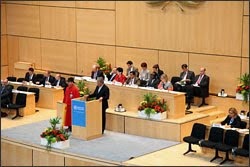
WHO/Jess HoffmanPRESS RELEASE: 'Sixty-third World Health Assembly unanimously adopts the WHO global Code of practice on the international recruitment of health personnel. Alliance members and partners applaud Member States. The Alliance 21/05/2010.

[Photo: WHO/Jess Hoffman. Dr Pierre François Unger, State Councillor of the Canton of Geneva, addresses delegates at the opening of the Sixty-third World Health Assembly.]

'Geneva, 21 May 2010 - In a historic move today, the Sixty-third World Health Assembly unanimously passed a resolution to adopt the voluntary WHO global Code of practice on the international recruitment of health personnel. With this step, the world's nations acknowledge the global dimension and complexities of the health workforce crisis and the interconnected nature of both the problems and the solutions.

'With this resolution, Member States commit themselves to the voluntary principles and practices for the ethical international recruitment of health personnel taking into account the responsibilities and rights of source and destination countries, other stakeholders, and those of the migrant health personnel themselves. The Code provides ethical principles applicable to the international recruitment of health personnel in a manner that strengthen the health systems of developing countries.

'A drafting committee was established on the first day of the Assembly and after three days of negotiations, stayed up till 4:30 am on Thursday, 20 May 2010 to seek consensus on a draft resolution that retained the principles and spirit of the Code while also representing a way forward for all countries.

'The draft was unanimously accepted at the tenth session of Committee A late evening on 20 May 2010 and brought long awaited joy and celebration to the many organizations and individuals, campaigners and professionals, institutions and Member States who had been working tirelessly since the last three years to see a meaningful and equitable resolution on the Code be adopted at the World Health Assembly.

'"The process was not always easy, but there was commitment from all Member States to see a resolution adopted. This helped to keep the process moving and the results are there to see" says Alliance Board member, Bjarne Garden, Assistant Director, Global Health and AIDS Department, NORAD, a member of the Norwegian delegation.

'"This brings to fruition the pioneering work seeded by the Alliance three years ago with the creation of the Health Worker Migration Initiative bringing together the Health Worker Migration Global Policy Advisory Council and WHO led team of technical experts. It is the result of the work of multiple stakeholders who have effectively rallied around together. The world is now a significant step closer to ensuring health workers are available and accessible to all", says Dr Mubashar Sheikh, Executive Director, Global Health Workforce Alliance.

'World Health Organization (WHO) has played a key role in coordinating the process. "The Code sets out a roadmap for implementation. Within 2 years WHO will provide guidance to countries on monitoring implementation of the Code, and then report to the Assembly on the progress against implementation. The Code is voluntary, but progress on implementation will be monitored and reviewed" explained Dr Manuel Dayrit, Director, WHO department of Human Resources for Health.

'Health personnel migration has been a clearly identified priority for the Alliance since its inception. During the First Global Forum on Human Resources for Health in March 2008, the Alliance endorsed the Kampala Declaration and Agenda for Global Action, which sparked broad interest in the creation of the Code.

'Progress on the code has been achieved as a result of consultations and discussions, particularly at all six WHO Regional Committees and national consultations, involving participation by a wide range of stakeholder groups. The UN ECOSOC meeting and the G8 Summit in July 2009, and the UN General Assembly in December 2009 had strongly supported and encouraged WHO to move forward in finalizing the draft code of practice. The 126th Session of the WHO Executive Board, January 2010, had discussed a revised draft of the Code and recommended that it be submitted to the 63rd World Health Assembly.

'At this momentous milestone, the Alliance and WHO call upon Member States and all its partners to reinforce its spirit of working together as they now gear up to implementing the code. The Alliance remains committed to facilitating the process and supporting sharing of information among Member States and all stakeholders.'

The Draft Resolution, dated 20 May 2010, is available here:
http://www.who.int/workforcealliance/knowledge/themes/migration/wha_A63_A_Confpaper_11.pdf

Key elements of the draft code (as described in The Lancet, 15 May) are:
  • Establishment of voluntary global standards for ethical international recruitment of health personnel, balancing rights and obligations of source states, destination states, and health personnel.
  • Promotion of coordination of national policies and international cooperation among states and their partners in health professions and civil society.
  • Recommendation that states strive to meet their domestic needs for health services with their own human resources through planning, education, and training for health workforce.
  • Recommendation that states ensure that international migration should have net positive effect on developing countries through technical assistance, support for health personnel training and retention, twinning of health facilities, and specialised technology and skills transfers.
  • Recommendation that states establish voluntary financial mechanisms to support efforts of developing countries to strengthen health systems.
  • Recommendation that states protect rights of migrant health workers through fair labour practices. In all terms of employment and conditions of work, migrant health personnel should enjoy same legal rights and responsibilities as domestically trained health workforce, without discrimination.
  • Recognition that health personnel have ethical responsibilities to cooperate with local authorities in interests of patients, health systems, and society.
  • Recommendation for national data collection and information exchange on health personnel migration, including establishment of national centre for information exchange, expansion and coordination of national research, and periodic reporting to WHO.
  • Promotion of compliance through periodic state reporting to WHA of measures taken to implement the code; and recommendation that WHA periodically reviews the code's implementation with input from non-governmental sources.
Allyn L Taylor & Lawrence O Gostin. International recruitment of health personnel. The Lancet, 375(9727)1673-1675, 15 May 2010
http://www.thelancet.com/journals/lancet/article/PIIS0140-6736%2810%2960596-X/fulltext?_eventId=login&&version=printerFriendly
(free access after free registration)


My source: HIFA2015 with photo addition

Saturday, May 22, 2010

Prognosis for NPfIT remains uncertain - 21 May 2010 - Computing

While the coalition government’s Programme for Government reiterates previous commitments around technology and civil liberties, IT procurement and broadband rollout, it is noticeably silent on the future of the NHS National Programme for IT (NPfIT), with no mention of Conservative promises prior to the election to dismantle the "NHS supercomputer" or the Liberal Democrats' pledge to scrap large parts of the NPfIT.
...

Prognosis for NPfIT remains uncertain - 21 May 2010 - Computing

Saturday, May 15, 2010

Holistic bandwidth (and the dangers) of political care

The attack on MP Stephen Timms here in the UK highlights not only the ongoing importance of personal safety for public service personnel, but how much politicians value their constituency work. It is no accident that these sessions are called "surgeries".

The politician meets not just a citizen, but a political obligation and duty to care. In the media reports it was interesting to hear of how much satisfaction MPs get from their constituency work. Listening to the reporting and debate prompted me to realise that although politicians vary in how well they engage and empathise with their constituents the problems they are asked to deal with covers a broad holistic spectrum. Consider this listing written by Tony Wright MP:
  • The education system
  • The transport system
  • The social services
  • Health services
  • Housing
  • The environment
  • Government bodies
  • The justice system
  • Immigration and asylum
  • Finances and employment
  • Trade unions
  • The media
I am a community nurse five days a week.

Our MPs are community politicians one day a week with 'Constituency Friday'.

So to The Rt Hon. Stephen Timms (and his staff) I wish you a speedy recovery and congratulations on the extent of you and your peer's constituency work.

Holistic in a word and deed.

Congratulations also to the Green Party on the success of their leader Caroline Lucas MP.

The Health Career Model: POLITICAL domain resources

Tuesday, May 11, 2010

Injustice: Why social inequality persists by Daniel Dorling

InjusticeI first came across the work of (Prof.) Danny Dorling in the 1990's in connection with workshops on visualization in the social sciences and Geographic Information Systems (GIS). The other week I read a feature on his (very timely) book in the Society section of The Guardian (O'Hara, 2010).

You do wonder exactly where we are in policy terms given the interval since the Black Report. Dorling's book then sounds like a must-read, with the information posted below from the publishers.


In addition in Waterstones at the weekend I found The Spirit Level, available on their 3 for 2 offer. The links also posted below with an insightful 2009 review of The Spirit Level by Daniel Ben-Ami on sp!ked; plus a related LGC & HSJ event:

Implementing the Recommendations of the Marmot Review:
Reducing Health Inequalities


Injustice: Why social inequality persists

About This Book

Few would dispute that we live in an unequal and unjust world, but what causes this inequality to persist? Leading social commentator and academic Danny Dorling claims in this timely book that, as the five social evils identified by Beveridge are gradually being eradicated, they are being replaced by five new tenets of injustice, viz:

  • elitism is efficient;
  • exclusion is necessary;
  • prejudice is natural;
  • greed is good; and
  • despair is inevitable.

In an informal yet authoritative style, Dorling examines who is most harmed by these injustices and why, and what happens to those who most benefit. Hard-hitting and uncompromising in its call to action, this is essential reading for everyone concerned with social justice.

"His attack on elitism and despair is impressive, his factual evidence undeniable." Rt Hon David Blunkett MP

Additional resources for Injustice: http://www.policypress.co.uk/injustice_appendix.asp

Dorling, D., Orford, S. and Harris, R. (1998) Visualization in the Social Sciences, A Report for the ESRC/JISC Advisory Group on Computer Graphics, AGOCG Technical Report No 41 (ISSN 1356-9066). Report as a PDF

O'Hara, M. (2010). Why Britain's battle to bring down social inequality has failed, p.1 of the SocietyGuardian section of the Guardian on Wednesday 21 April 2010.

The Spirit Level: book

The Equality Trust, established by the authors.

Distorting the spirit of equality, sp!ked review of books.

Thursday, April 1, 2010

CARE: Whether NHS or Social Care ...

CA
RE


Whether -
NHS or Social Care*
what
C.A.R.E.
is crying out for is a
universal, shared, holistic and wholly integral conceptual framework.
Then and only then will the currencies# of care be
transferable, translatable and transforming!

* Private, 3rd sector, religious order, or social enterprise ...
# Currencies does not just refer to finance.

Wednesday, March 31, 2010

Launch of the National Care Service in England

Source: Department of Health, 30/03/2010

In the biggest change to the welfare state since the creation of the NHS, everyone who needs care when they are old or disabled will get it for free, Health Secretary Andy Burnham announced today as he launched the National Care Service in England.

The National Care Service will be based on a principle of shared social insurance and will be funded by contributions from everyone in a fair way. The National Care Service will ensure people get high quality care when they need it and it will give peace of mind that savings and homes will be protected from the expensive care costs that arise from serious long term conditions, such as Alzheimer’s or recovering from a stroke.

Andy Burnham said:
“Today we are launching a National Care Service that is fair for all, ending the cruel care lottery we have today. Like the NHS, everyone will contribute and everyone will get their care for free when they need it. This is the biggest change to the welfare state since 1948 and, like the NHS, it’s going to take time to build.

“The National Care Service will mean that people will be treated with dignity and respect, people will have control and choice over their care and they will be helped to stay in their homes for as long as possible. People who have to live in residential care will, from 2014, get their care for free after two years and there will be more help to pay the residential costs.

“We’re not replacing the millions of carers or families who look after each other. They are the underlying principle of the National Care Service and we will better support them.

“We’ve already laid strong foundations through reforms over the past few years. But, with an ever growing older population – there will be 1.7 million more people needing care in the next 20 years – we must radically overhaul the way care is paid for and provided.

“I feel very strongly that this is a responsibility we must all help to shoulder. And it’s clear from what we have heard from the thousands of people who have given us their opinions on this over the past twelve months, that people agree. That’s why we know that the fairest way to help everyone who is affected by a serious disease, illness or disability is for us all to pay into a system so we get free care when we need it.”
The cost of care is currently a cruel lottery. No one has any way of knowing how much care and support they may need in the future. A 65-year-old can expect to need care costing on average £30,000 during retirement. However, some people, for example people with severe dementia, could end up needing care costing as much as £200,000.

The National Care Service will put an end to this unfair system. It will be built on strong foundations of recent reforms and will overhaul the way care and support is paid for and provided. It cannot be built overnight and will be phased in three stages:

Stage One
• Build on the best of the current system through reforms that are already underway and deliver the Personal Care at Home Bill.

Stage Two
• From 2014 extend the coverage of free care so that people will receive free care if they need to stay in residential care for more than two years.
• Set up a commission to support consensus and advise the Government on the fairest and most sustainable way that people can make their contribution to a care system which is free when they need it.
• Set up a National Care Service Leadership Group of expert stakeholders who will advise Government on the implementation of the National Care Service, focussing on the systems and business processes that need to be put in place to make the National Care Service a reality.
• Introduce a National Care Service Bill to set the legal foundations of the National Care Service.
• Enshrine in law for the first time nationally consistent eligibility criteria for social care helping to remove the postcode lottery of care that exists now
• Push forward with the prevention agenda and continue the drive towards personal budgets so that by 2012 everyone who would benefit from a personal budget will have one.
• Ensure accurate, relevant and accessible information about what people are entitled to, how the assessment process works and how to access care services is provided to everyone.
• We want to improve the gateway for accessing social care and disability benefits to make simpler and easier for people.
• Introduce a quality framework including a body to drive up quality in social care.

Stage Three
• The introduction of a comprehensive National Care Service that is free when they need it for all adults with an eligible care need, funded by contributions.


Following the biggest ever consultation on care and support that saw over 68,000 members of the public, carers and representative organisations have their say, it is clear that people believe it is right that everyone should contribute to a care system that is free when people need it– similar to the NHS. However, the necessary consensus on how people should pay into such a system has not yet been reached. A National Care Service Commission, will therefore be established to advise Ministers on the fairest and most sustainable way for people to do so.

Care Services Minister Phil Hope said:
“We must find a fair way of funding the National Care Service. The stakes are very high. That’s why we must have a clear consensus. We are setting up a commission to tell us what would be a fair way for everyone to pay into this new system.

“Everyone will pay into it in a fair way and in return everyone will then have peace of mind that their savings and homes will be protected from high care costs. The whole of society will benefit and the National Care Service will support individuals and families for generations to come.”
The National Care Service will have six founding principles. It will:
  1. Be universal – supporting all adults with care and support needs within a framework of national entitlements.
  2. Be free at the point of use – based on need, rather than the ability to pay.
  3. Work in partnership – with all the different organisations and people who support individuals with care and support needs day-to-day.
  4. Ensure choice and control – treating everyone with respect and dignity, ,putting people in charge of their lives.
  5. Support family, carers and community life – recognising the vital contribution families, carers and communities play in enabling people to realise their potential.
  6. Be accessible – easy to understand, helping people make the right choices.

Contacts: Department for Health Email: NDS.DH at coi.gsi.gov.uk

Additional links:

DoH: 30 March 2010, The White Paper, Building a National Care Service

The Big Care Debate

Sunday, March 21, 2010

Global Pulse 2010 March 29th - 31st #gp2010

I have just registered for:


From March 29th through March 31st you will have the chance to participate in something truly exciting. Inspired by President Obama’s “New Beginnings” speech to Cairo University, the U.S. Government is hosting Global Pulse 2010, an innovative, online brainstorming discussion.

During this unique event, individuals throughout the world will have a chance to participate in and influence a global conversation centered on 10 hot-button social issues facing the global community within the fields of science and technology, entrepreneurship, and human development.

MARK YOUR CALENDARS!

GANM's - Dr. Patricia Abbott will be a featured expert during the event. She will host a discussion on E-Health from 11:00am-noon (eastern time) on March 30, 2010.

Why is Global Pulse 2010 important?

Global Pulse 2010 will offer a unique way for community members to connect and engage, build new relationships and share their ideas on how we can strengthen our global partnerships to better address our shared global challenges.

Global Pulse 2010 is an open forum that will highlight ten broad topics:
  • Empowering Women and Girls
  • Enabling Essential Education
  • Building Stronger Partnerships
  • Exercising Political and Civil Rights
  • Inspiring a New Generation
  • Promoting Global Health
  • Advancing Entrepreneurship, Trade & Economic Opportunity
  • Fostering Science, Technology & Innovation
  • Supporting a Sustainable Planet
  • Pursuing Grand Challenges
How to Register for Global Pulse 2010?

To register please visit:https://www.collaborationjam.com/minijam3/globalpulse2010/registration/
For more information, please visit us at www.GlobalPulse2010.gov

You may also join us on Facebook, Twitter, Orkut, and LinkedIn to stay up to date on key Global Pulse 2010 activities. Stay tuned for more information on Global Pulse 2010!

PLEASE NOTE: We want to hear from your network. If you know of others who would be interested in participating in this event, please feel free to forward this email. As there are a limited number of virtual seats in Global Pulse 2010, we ask that these individuals complete and submit this brief form available at www.GlobalPulse2010.gov/registration Pending the number of available seats, slotted individuals will be notified so that they may then formally register to participate in Global Pulse 2010.

My source:
GANM (Global Alliance for Nursing and Midwifery)

Monday, March 15, 2010

Prime Minister’s Commission on the Future of Nursing and Midwifery in England – 2010

Earlier in March The Prime Minister’s Commission on the Future of Nursing and Midwifery in England published its final report.

You can download the report in full.

Box 3.1.2 (on page 43) features key statistics on nursing and midwifery:
  • In 2009 there were nearly 595,000 RNs on the register residing in England, 77% of them registered in the adult nursing branch.
  • In 2009 there were over 31,000 RMs on the register residing in England.
  • Nine out of 10 of RNs in England are female.
  • There are disproportionate numbers of men in more senior nursing positions and certain specialties: a third of mental health nurses, for example, are male.
  • Nearly all RMs in England are female. There are 131 male midwives.
  • Well over half the RNs and RMs working in the NHS in England (57%) are aged between 35 and 54, with less than 3% under 25. Almost 70% of RNs and RMs on the NMC register in England are aged 40 and over.
Reporting on the Commission's report the RCN Bulletin (10 March) notes the need to encourage more men into the profession and people from black and ethnic minority groups. As the list above highlights, however - There are disproportionate numbers of men in more senior nursing positions and certain specialties: a third of mental health nurses, for example, are male.

From my early nurse education days (especially from mental health to general nursing) you had no choice, but be aware of gender and just w(h)ere you had landed. Upon my first encounter with Hodges' model, the model stood out in the list of theories and models of nursing.

It was not listed on the original nursing theory website.
(Hence, the initial website project)
The majority of models and theories were created by women and outside England.#

The future of nursing depends on successfully addressing* the numbers: totals, proportions, recruits, retirees*. ... We can use the numbers, quality, safety and I have to say - Hodges' model to help craft the creative and innovative messages needed. We really are in for a fascinating and exciting 20-30 years in nursing; here in the UK, EU and Internationally. There is much more in the Commission's report to reflect upon which will follow here. ...

http://cnm.independent.gov.uk/

* Note the use of 'addressing' not balancing - that's why this is also challenging.
# This is not a complaint, just an observation.


Additional link:

Sciences care domain: Nursing theory and models of care resources

Tuesday, March 2, 2010

Person-centred care and semantic inflation

Time laughs at us, with us and has the last laugh. If you are ever complacent and by virtue of your years you venture to think to yourself:

Well we've been working on this now for 20-30 years look at the progress we've made. ...

Time is always there to remind you:
Hey, just who are you trying to fool?
You are a lifelong learner!

The number of personnel and services that describe themselves as person-centred is an ongoing theme of so many CVs, policies, SLAs, commissioning and consultant's presentations and lectures. ...

Whether in a ward, service, or organisation's philosophy, person-centred is a term that is being diluted to the extent that semantic inflation devalues what is supposed to be the main currency? Or are we admitting that this is the cost of the political games that people play? Whatever your view, there are insights of progress won, but also reminders on how much remains to be done.

Health and social care being multicontextual demands the existence of multiple currencies. One additional currency begs that we compare A, B, C with the evidence base.

If this is the crucible of our person-centred times then what is burning?
  • Nursing ethics?
  • Nursing education?
  • Idealistic aspiration? (Yes, we will get there!)
  • New Age incense?
  • Policy initiatives?
  • Funding allocations?
  • Nursing activism (Or, are there any balls in the house)?
  • Service infrastructures?
Although the media temperature is rising here in the UK, as health, itself economically recumbent is moved to ICU being so politicised; the Francis Report provides evidence of a dire lack of person-centred care. Recalling my basic nurse training: what can be more person-centred than ensuring that a patient has the necessary fluids and diet?

For women who suffer a miscarriage - where should they be nursed as debated in today's Guardian newspaper? What is person-centred care in maternity and gynaecology services?

In-patient provision and transitions from child-youth-adult provide other opportunities and major challenges for health and social care to demonstrate their person-centredness.

There are so many ways to be person-centred, so many levels, some may even be contradictory(?).

book cover
I wonder how many of those people highlighted in the Francis Report also had a form of dementia - whether diagnosed or not? Personhood and the need to acknowledge and sustain the person are not new.

Even if a service is person-centred in terms of the environment, meal choices, therapeutic options, belongings, personal space, proximity to home and relatives ... the crux at the center is the attitude of staff, and their having the time and space:


"to be"

person-centred

Additional links:

Mumsnet

Atkins, L. (2010) NHS 'must lessen trauma of miscarriages' Parents web forum Mumsnet calls for new code of practice to help women who lose their babies, The Guardian, Tuesday 2 March.

Image source:
http://drugsreference.co.uk/books/books.php?cat2=Caregiving