Showing posts with label WHO. Show all posts

Monday, August 9, 2010

Achieving the health-related MDGs. It takes a workforce!

Dear colleagues,

With reference to the upcoming MDG Summit and the UN Global Strategy for Women's and Children's Health, Dr Manuel Dayrit would like to share with you the above-mentioned page that was published today on the HRH website, which highlights the human resources for health situation in the 49 focus countries.

Achieving the health-related MDGs. It takes a workforce!
Link: http://www.who.int/hrh/workforce_mdgs/en/index.html

Density of doctors, nurses and midwives in the 49 priority countries
Link: http://www.who.int/hrh/density_chart.pdf

Please note that the link to the chart is:
http://www.who.int/hrh/fig_density.pdf

Kind regards,

Rebecca Bailey on behalf of Dr Manuel Dayrit
Rebecca J. Bailey, MSPH, CEd
Technical Officer
Health Workforce Education and Production
WHO/HSS/HRH

My source:
Ellen BONITO: bonitoe at wpro.who.int
GANM (Global Alliance for Nursing and Midwifery): GANM at ibp.wa-research.ch


<->

In Mevagissey, Cornwall last month browsing in Hurley Books, I came across a copy of Maps and Diagrams: Their Compilation and Construction by F.J. Monkhouse, et al. (1967). At three pounds - a historical bargain. Prompted by the charts above I will scan the cover and share some of the text/ideas here in the near future.

I was saddened to see that in Padstow The Strand Bookshop has closed - apparently in January 2009. As a listed building who knows perhaps it might smell of books once again!

Saturday, July 24, 2010

WHO Guidance Global Discussion Forum 26 July - 6th August, 2010

Announcement:

Please pass this invitation onto to your networks and colleagues and encourage them to join this virtual discussion forum.

The World Health Organization (WHO) and the WHO Guidance forum invite you to join the

WHO would like you to join a 2 week virtual discussion forum designed to provide an opportunity for people to share their ideas, experience and opinions about the type of evidence-based guidance WHO should produce to support the reduction of maternal and perinatal mortality and morbidity. We want to make this guidance more accessible and focused on addressing technical and health systems challenges and meeting the information needs of people working in this field.

Your contribution to this discussion will help us to identify priority policy or practice issues in which it would be helpful to have either a policy brief, guideline or other type of resource materials produced.

REGISTER NOW! http://my.ibpinitiative.org/whoguidance

During this two-week forum you will receive one-two emails per day: one email to introduce the day’s questions, and one daily digest of the contributions. Five questions will be addressed, and each discussed over two consecutive days. All contributions received will be acknowledged.

Once you have registered you can participate in the forum simply by responding to the daily e-mails or sending a message to:

whoguidance at my.ibpinitiative.org

For any questions on this Virtual Global Discussion Forum please contact the forum facilitator: Cordelia Coltart at: coltartc at who.int

Many thanks and we look forward to hearing your views during this exciting venture.

Cordelia Coltart
Intern WHO
MBBS MPH MRCP BSc DTM&H
Reproductive Health and Research
E-mail: coltartc at who.int

World Health Organization
20, avenue Appia
CH-1211 Geneva 27
visit WHO at: www.who.int

My source:
Sandra Land, GANM (Global Alliance for Nursing and Midwifery) ganm at ibp.wa-research.ch

Sunday, May 23, 2010

63rd World Health Assembly unanimously adopts the WHO global Code of practice on the international recruitment of health personnel

Dear HIFA2015 colleagues,

Please find below a press release from the Global Health Workforce Alliance. In the words of Dr Mubashar Sheikh, GHWA Executive Director: "The world is now a significant step closer to ensuring health workers are available and accessible to all".
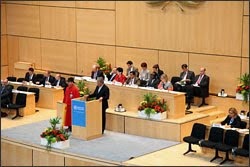
WHO/Jess HoffmanPRESS RELEASE: 'Sixty-third World Health Assembly unanimously adopts the WHO global Code of practice on the international recruitment of health personnel. Alliance members and partners applaud Member States. The Alliance 21/05/2010.

[Photo: WHO/Jess Hoffman. Dr Pierre François Unger, State Councillor of the Canton of Geneva, addresses delegates at the opening of the Sixty-third World Health Assembly.]

'Geneva, 21 May 2010 - In a historic move today, the Sixty-third World Health Assembly unanimously passed a resolution to adopt the voluntary WHO global Code of practice on the international recruitment of health personnel. With this step, the world's nations acknowledge the global dimension and complexities of the health workforce crisis and the interconnected nature of both the problems and the solutions.

'With this resolution, Member States commit themselves to the voluntary principles and practices for the ethical international recruitment of health personnel taking into account the responsibilities and rights of source and destination countries, other stakeholders, and those of the migrant health personnel themselves. The Code provides ethical principles applicable to the international recruitment of health personnel in a manner that strengthen the health systems of developing countries.

'A drafting committee was established on the first day of the Assembly and after three days of negotiations, stayed up till 4:30 am on Thursday, 20 May 2010 to seek consensus on a draft resolution that retained the principles and spirit of the Code while also representing a way forward for all countries.

'The draft was unanimously accepted at the tenth session of Committee A late evening on 20 May 2010 and brought long awaited joy and celebration to the many organizations and individuals, campaigners and professionals, institutions and Member States who had been working tirelessly since the last three years to see a meaningful and equitable resolution on the Code be adopted at the World Health Assembly.

'"The process was not always easy, but there was commitment from all Member States to see a resolution adopted. This helped to keep the process moving and the results are there to see" says Alliance Board member, Bjarne Garden, Assistant Director, Global Health and AIDS Department, NORAD, a member of the Norwegian delegation.

'"This brings to fruition the pioneering work seeded by the Alliance three years ago with the creation of the Health Worker Migration Initiative bringing together the Health Worker Migration Global Policy Advisory Council and WHO led team of technical experts. It is the result of the work of multiple stakeholders who have effectively rallied around together. The world is now a significant step closer to ensuring health workers are available and accessible to all", says Dr Mubashar Sheikh, Executive Director, Global Health Workforce Alliance.

'World Health Organization (WHO) has played a key role in coordinating the process. "The Code sets out a roadmap for implementation. Within 2 years WHO will provide guidance to countries on monitoring implementation of the Code, and then report to the Assembly on the progress against implementation. The Code is voluntary, but progress on implementation will be monitored and reviewed" explained Dr Manuel Dayrit, Director, WHO department of Human Resources for Health.

'Health personnel migration has been a clearly identified priority for the Alliance since its inception. During the First Global Forum on Human Resources for Health in March 2008, the Alliance endorsed the Kampala Declaration and Agenda for Global Action, which sparked broad interest in the creation of the Code.

'Progress on the code has been achieved as a result of consultations and discussions, particularly at all six WHO Regional Committees and national consultations, involving participation by a wide range of stakeholder groups. The UN ECOSOC meeting and the G8 Summit in July 2009, and the UN General Assembly in December 2009 had strongly supported and encouraged WHO to move forward in finalizing the draft code of practice. The 126th Session of the WHO Executive Board, January 2010, had discussed a revised draft of the Code and recommended that it be submitted to the 63rd World Health Assembly.

'At this momentous milestone, the Alliance and WHO call upon Member States and all its partners to reinforce its spirit of working together as they now gear up to implementing the code. The Alliance remains committed to facilitating the process and supporting sharing of information among Member States and all stakeholders.'

The Draft Resolution, dated 20 May 2010, is available here:
http://www.who.int/workforcealliance/knowledge/themes/migration/wha_A63_A_Confpaper_11.pdf

Key elements of the draft code (as described in The Lancet, 15 May) are:
  • Establishment of voluntary global standards for ethical international recruitment of health personnel, balancing rights and obligations of source states, destination states, and health personnel.
  • Promotion of coordination of national policies and international cooperation among states and their partners in health professions and civil society.
  • Recommendation that states strive to meet their domestic needs for health services with their own human resources through planning, education, and training for health workforce.
  • Recommendation that states ensure that international migration should have net positive effect on developing countries through technical assistance, support for health personnel training and retention, twinning of health facilities, and specialised technology and skills transfers.
  • Recommendation that states establish voluntary financial mechanisms to support efforts of developing countries to strengthen health systems.
  • Recommendation that states protect rights of migrant health workers through fair labour practices. In all terms of employment and conditions of work, migrant health personnel should enjoy same legal rights and responsibilities as domestically trained health workforce, without discrimination.
  • Recognition that health personnel have ethical responsibilities to cooperate with local authorities in interests of patients, health systems, and society.
  • Recommendation for national data collection and information exchange on health personnel migration, including establishment of national centre for information exchange, expansion and coordination of national research, and periodic reporting to WHO.
  • Promotion of compliance through periodic state reporting to WHA of measures taken to implement the code; and recommendation that WHA periodically reviews the code's implementation with input from non-governmental sources.
Allyn L Taylor & Lawrence O Gostin. International recruitment of health personnel. The Lancet, 375(9727)1673-1675, 15 May 2010
http://www.thelancet.com/journals/lancet/article/PIIS0140-6736%2810%2960596-X/fulltext?_eventId=login&&version=printerFriendly
(free access after free registration)


My source: HIFA2015 with photo addition

Wednesday, March 31, 2010

MCQ (answer) on clinical coding and classification

The answer to the multiple choice question is item 4:

- a product of the 18th century driven by death?

François Bossier de Lacroix (1706-1777*), better known as Sauvages, is credited with the first attempt to classify diseases systematically.

Sauvages' comprehensive treatise was published under the title Nosologia methodica.

A contemporary of Sauvages was the great methodologist Linnaeus (1707-1778), one of whose treatises was entitled Genera morborum.

Beginning of the 19th century, the classification of disease in most general use was one by William Cullen (1710-1790), of Edinburgh, published in 1785 under the title Synopsis nosologiae methodicae.

My source:
http://www.who.int/classifications/icd/en/HistoryOfICD.pdf

* I note sources that record Sauvage's year of death as 1767.
http://www.persee.fr/web/revues/home/prescript/article/rhs_0048-7996_1969_num_22_4_2601

Friday, March 26, 2010

MCQ (question) on clinical coding and classification

Q. The development of clinical coding and classification systems, such as International Classification of Diseases (ICD) is …
  1. a manifestation, since the 1960s, of health care specialisation and technology in medicine?
  2. a product of the National Programme for Information Technology and the International Health Terminology Standards Development Organisation (IHTSDO)?
  3. a product of Körner statistics and resource management in the 1990s?
  4. a product of the 18th century driven by death?
  5. an international initiative prompted by The Plague and launched by Dr Who?

Answer and further reading to follow next month.

Tuesday, February 16, 2010

NT: Nurses urged to use checklists to reduce human error in practice

Last month Nursing Times included an item on checklists, highlighting work by the WHO in perioperative nursing and the Patient Safety First campaign. Following surgery's lead is the realisation that similar checklists have the potential to improve communication and team working in other areas such as nutrition, situational awareness and pressure ulcer care.

Checklists are ubiquitous in our day-to-day lives, the dividend for using them is fairly obvious. What is less obvious is the fact that checklists alone are dead bureaucratic adornments. Checklists are animated by situations and thinking, reflective individuals in those situations. As Lomas reports there is a need to stop at an agreed key point in the patient pathway and ask the critical - checklist - questions. In team work this co-ordinated acknowledgement to complexity is essential for comprehensive, consistent and safe care.

What is interesting here is the emphasis on human factors. While checklists undoubtedly have a demonstrated - proven - role to play in safety, situational awareness is not a product of checklists alone. There is a need for learning and for the cultivation of cognitive lists. While human memory is fallibility incarnate - hence the role for checklists - there is also the need for skilled, knowledgeable professionals with the required communication and observational skills. The need for nurses to further develop observational skills has also been highlighted over recent months.

So as checklists are checked and logged: prepare a space for the mental checklist that is Hodges' model. The model is situated, person-centered and one of the original purposes was to help bridge the theory - practice gap. Try doing that with a checklist: alone

Clare Lomas Safety checklists could cut 'human error' in clinical practice, Nursing Times, 106, 3, 26 January 2010, p.2.

Monday, December 28, 2009

Call for papers: IFLA Health and Biosciences Libraries Section open session

HBS logo

Colleagues from around the world are invited to submit an abstract for consideration for the HBS Open Session:

Health and Biosciences Libraries Section


Aim and Scope of the Session


It is hoped that papers will cover a wide range of areas - for example:
  • Partnerships and collaborations that support free access to health information.
  • Health libraries/health information professionals role in promoting open and / or equitable access.
  • How health information is disseminated to the general public?
  • How useful is free health information? Is it evidence based?
  • How evidence based information is incorporated into freely available health information?
  • Is there a decline in the use of health information that is not freely available e.g. library subscriptions?
  • How do consumers prefer to access health information e.g. mobile devices, magazines, newspapers?
  • What role health information literacy may have in health information?
It is anticipated that presentations be 15 minutes with time for questions at the end of the session.

Important dates:

February 1st 2010: Deadline for submission of abstract
March 1st 2010: Notification of acceptance/rejection
May 1st 2010: Deadline for submission of text

Submission Guidelines:

The proposals must be submitted in an electronic format and must contain:

Title of paper
Summary of paper (250 - 350 words maximum)
Speaker's name, address, telephone and fax numbers, professional affiliation, email address and biographical note (40 words)

Submissions are to be submitted before February 1st 2010 by email to:

Paivi Pekkarinen
National Library of Health Sciences
Haartmaninkatu 4
FI-00290 Helsinki, Finland
paivi.pekkarinen@helsinki.fi
www: http://www.terkko.helsinki.fi

Regrettably IFLA's Sections do not have funds available to pay for speakers expenses, including registration for the conference, travel, accommodation.

http://www.ifla.org/en/calls-for-papers/1930


Paivi Pekkarinen
IFLA Health and Biosciences Libraries Section / Secretary
National Library of Health Sciences
Haartmaninkatu 4
FI-00290 Helsinki
email: paivi.pekkarinen at helsinki.fi

HIFA2015 profile: Paivi Pekkarinen is Head of the WHO Information Service Centre, National Library of Health Sciences, Finland. Professional interests include:
  • To enhance equal access to health information, in particular in the WHO European Region;
  • To enhance collaboration and networking of the Public Health Special Interest Group of EAHIL http://www.eahil.net/PHISIG-page.html;
  • and knowledge management issues.
Click here to read online.

HIFA2015: Healthcare Information For All by 2015 www.hifa2015.org
With thanks to our 2009 Sponsors: *British Medical Association, ePORTUGUESe, Network for Information and Digital Access, Royal College of Midwives, Royal College of Nursing*

To join or unsubscribe from HIFA2015, email:
hifa2015-admin at dgroups.org
To join our sister group CHILD2015 (child health), go to:
www.hifa2015.org/child2015-forum
To join our sister group HIFA2015-Portuguese, go to:
www.hifa2015.org/hifa-pt

My source:
HIPNet Listserv hjohnson at jhuccp.org

Tuesday, October 21, 2008

Two vacancies students - young professionals @ WHO Geneva

Marvellous opportunities. ...

Dear colleagues,

Please help us in disseminating two vacancy notices issued by the World Health Organization for opportunities for promising students and young professionals in our Geneva headquarters.

In particular, we are looking for persons with quantitative skills to work on global health workforce information, monitoring and research. We are currently looking to recruit one full-time professional (as per the vacancy notice HQ/08/HQ/HRH/FT861 - see link below).

We are also continuously open to offering (unpaid) internship opportunities.

Full details can be found at: http://www.who.int/employment/en/

Thanking you in advance,

Neeru Gupta

Demographer-Statistician, PhD
Department of Human Resources for Health
World Health Organization
Avenue Appia 20, Geneva 1211, Switzerland
Tel.: 41-22-791-1066 / Fax: 41-22-791-4747
Email: guptan at who.int


My source: ESDS Government mailing list