Showing posts with label information. Show all posts

Tuesday, February 8, 2011

Health Literacy: A Public Health concern? 1-day Conference, Manchester, UK

Venue: Chancellors Hotel and Conference Centre (Manchester)

Friday 10th June 2011

Join us for our first national Health Literacy Research Conference.

Health literacy is -
‘the cognitive and social skills which determine the motivation and ability of individuals to gain access to, understand, and use information in ways which promote and maintain good health’.

We welcome applications for oral presentation or posters on Health Literacy research and development. The abstract submission guidelines are available from the website http://www.healthliteracy.org.uk/

or Lucy McDonald: mcdonall AT lsbu.ac.uk

The conference will include 2 plenary sessions with international health literacy
keynote speakers and a panel discussion.

Cost: £60 per day

My source: Lucy McDonald

Monday, February 7, 2011

h2cm: philosophy of science - analytical AND dialectical Refinetti, R. (1989).

"For centuries, philosophers have discussed whether knowledge progresses analytically or dialectically. In the Cartesian tradition of starting with simple concepts and then building up more complex concepts [4], the idea of science as a gradual accumulation of small pieces of knowledge was put forward by Auguste Comte [5]. This constitutes an analytical view of the progress of knowledge. On the other hand, Hegel proposed that knowledge grows as a whole, so that contradictions between opposing ideas are solved (and disperse pieces of knowledge are integrated) at each stage of the dialectical progress of knowledge [6]. This constitutes a dialectical view of the progress of knowledge.

The partial correctness of both the analytical view of Comte and the dialectical view of Hegel have been acknowledged for many years. Wisdom from both views can be found in the writings of many contemporary philosophers of science." Refinetti, R. (1989) p.583.


.... and can also be found within the structure and potential content of the Health Care Domains Model. Goethe in his own way(s) of seeing recognised the same...


Refinetti, R. (1989). Information processing as a central issue in philosophy of science, Information Processing & Management, 25, 5, 583-584.

Tuesday, December 28, 2010

Links of interest c/o HIFA2015 list

The following links appeared in recent HIFA2015 Healthcare Information For All posts:

AuthorAID: http://www.authoraid.info/ is a global research community that provides networking, mentoring, resources and training for researchers in developing countries.

IICD - Information and Communication Technologies (ICT) for Development: http://www.iicd.org/

Education for Health: http://www.educationforhealth.net/ an Open Access Journal.

Scientific Eletronic Library Online: Scientific Eletronic Library Online

Welsh Annual Conference 2010: http://www.welshconfed.org/WelshAnnualConference2010.htm

Welsh Information Literacy Framework: http://www.library.wales.org/index.php?id=7498

PLoS journal on Neglected Tropical Diseases: http://www.plosntds.org/home.action

Knowledge 4 Health eToolkits: http://www.k4health.org/toolkits

NCBI.NCI Paper: Poor reporting and inadequate searches were apparent in systematic reviews of adverse effects http://www.ncbi.nlm.nih.gov/pubmed/18394536

Health Speaks: pilots result in 266 new local language health articles http://blog.google.org/2010/12/health-speaks-pilots-result-in-266-new.html

ERMED: Electronic Resources in Medicine Consortium http://www.nmlermed.in/

Global Health and Prevention calendar: http://www.pitt.edu/~super1/lecture/lec40851/index.htm

Monday, December 13, 2010

h2cm = Bayesian Quarters?

INTERPERSONAL : SCIENCES
SOCIOLOGY : POLITICAL
The Bayesian approach allows human insight, subjective though it is, to be combined with statistical information, limited though it may be. It is not surprising that this blurring of the line between the methodologies of the sciences and the humanities has attracted passionate supporters as well as furious enemies on both sides of the cultural divide.
Von Baeyer (2003) p.79.

von Baeyer, H.C. (2003) Information: The New Language of Science, Weidenfeld and Nicolson, London.

Tuesday, November 9, 2010

Grand Challenges for Global Health: 15th - access to clean, clear, knowledge

Dear HIFA2015 colleagues,

The news item below is forwarded from the Global Health Council, which reports the mHealth Summit taking place this week in washington DC. It is especially good to see that Bill Gates is giving a keynote address. This suggests that the Gates Foundation may be poised to address the 15th Grand Challenge for Global Health, as proposed by international health leaders in The Lancet:
"The Gates Foundation identified fourteen challenges [Grand Challenges for Global Health] but a fifteenth challenge stares us plainly in the face: The 15th challenge is to ensure that everyone in the world can have access to clean, clear, knowledge - a basic human right, and a public health need as important as access to clean, clear, water, and much more easily achievable."
Tikki Pang (WHO), Muir Gray (NHS, UK), and Tim Evans (WHO): 'A 15th grand challenge for global public health.' The Lancet 2006; 367:284-286.
http://www.thelancet.com/journals/lancet/article/PIIS0140673606680501/fulltext

When HIFA2015 was in planning back in 2006, the lead author of the above paper, Dr Tikki Pang (Director of Research policy and Cooperation at WHO) said: 'HIFA2015 is an ambitious goal but it can be achieved if all stakeholders work together'. Bill and Melinda Gates are critical stakeholders. I look forward to see Bill Gates' presentation. Will the Gates Foundation take up the 15th Challenge? Will the Gates Foundation prioritise the challenge of health information for all by 2015?

Bill Gates keynote yesterday is not yet available on the web, but it will be soon at: http://mhealthsummit.org/conference/live-webcast

I hope that Bill Gates will use this opportunity to articulate a clear and specific vision from the Gates Foundation: a vision of a world where people are no longer dying for lack of access to appropriate, reliable healthcare information. With their support, there is no doubt this vision can and will be realised.

With best wishes,
Neil

HIFA2015 profile: Neil Pakenham-Walsh is the coordinator of the HIFA2015 campaign and co-director of the Global Healthcare Information Network. He started his career as a hospital doctor in the UK, and has clinical experience in rural Ecuador and Peru.  For the last 20 years he has been committed to improving the availability of healthcare information for health workers in developing countries. He has worked with the World Health Organization, the Wellcome Trust, Medicine Digest and INASP (International Network for the Availability of Scientific Publications). www.hifa2015.org  neil.pakenham-walsh AT ghi-net.org

My source:  www.hifa2015.org

Sunday, October 31, 2010

New: The Journal of Humanities and Information Systems


Dear colleagues

It is my pleasure to announce a new journal, published by IBIMA, that will cater for articles in the interdisciplinary field of Information Systems and the Humanities (JHIS). This is a call for submissions for the first edtion of JHIS.

JOURNAL DESCRIPTION

The Journal of Humanities and Information Systems (JHIS) is an international peer reviewed and applied research journal that publishes papers on the symbiotic relationship between the two disciplines of Information Systems and the Humanities. Its unique focus will be research on Humanities-enriched IS, but other Humanities-Computing papers and case studies will also be considered. All papers will be subjected to a multiple blind peer review process. Papers should contribute to the existing body of knowledge of the domain in terms of theory and/or practice.

MISSION

JHIS aims to create an international forum to discuss and evaluate studies that implement theoretical constructs borrowed from the Humanities in various aspects of Information Systems, as well as investigations regarding the application of information technology in the Humanities. The creation of
publication opportunities for research with refreshing angles, some borrowed from other sciences, is a conscious effort to share interest and useful research and to counteract rigid procedures that are "stifling the intellectual advancement of our discipline" (Shoib and Nandhakumar, 2009).

SCOPE

Topics of interest for this journal include, but are not limited to, the following list:
  • Linguistics and Information Systems
  • History and Information Systems
  • Art and Information Systems
  • Philosophy and Information Systems
  • Law and Information Systems
  • Hermeneutics and Information Systems
CALL FOR ARTICLE SUBMISSIONS TO JHIS

Since there still are limited publication opportunities for Information System scientists (cf. Straub, 2009:v) in comparison with some other older, well-established disciplines, new opportunities should be embraced and used in order to build our discipline. Therefore, our colleagues are invited to submit some of their research outputs to this new outlet.

ASSOCIATE EDITORS AND PEER REVIEWERS

Please let me know if you would be interested to become an associate editor or peer reviewer of JHIS.
The editors and reviewers of JHIS should be like diamond miners taking a positive view while looking for "exciting forays into new research domains" (Straub, 2009:vii). The general aim in the review processes of this new journal will be to be inclusive and developmental rather than to perform "a
modern hygiene ritual", because we agree with Wastell and MacMaster (2008:64) that "a high rejection rate implies a collective failure of scholarship not the intellectual prosperity of a field".

For more information about the journal and submissions, see:
http://www.ibimapublishing.com/journals/JHIS/jhis.html

Jan H. Kroeze, School of Computing, University of South Africa
(editor-in-chief)

My source:
Humanist Discussion Group, Vol. 24, No. 451
Centre for Computing in the Humanities, King's College London
www.digitalhumanities.org/humanist

Friday, October 29, 2010

HCI 2011 Health, Wealth and Happiness Call for Papers


The 25th British Conference on Human-Computer Interaction (HCI2011)

July 4th - 8th, 2011 at Northumbria University, Newcastle-upon-Tyne, UK.

The HCI Educators conference, Workshops and Tutorials will be held on 4th and 5th July, 2011 and a Doctorial Consortium on the 5th July. The main conference runs from the 6th-8th July, 2011. HCI 2011 is organised by the PaCT Lab (Northumbria University) in cooperation with the British Computer Society.

This year we will be looking for papers to put in our alt.hci sessions. So if you think your work doesn't usually make it into this conference then maybe this year is your year.

Accepted papers will be published by BCS in the annual conference proceedings, freely available online in BCS Electronic Workshops in Computing (eWiC) and will also be included in the ACM digital library.

Important Dates:
  • Full Paper and Workshop submission: 21st January, 2011
  • Workshop notification of acceptance: 11th February, 2011
  • Work in Progress and alt.chi submission: 18th February, 2011
  • Short and Posters  submission: 18th February, 2011
  • Demos and Experiences submission: 18th February, 2011
  • Doctoral Consortium 18th February, 2011
  • Panels: 18th February, 2011
  • Notification of Acceptance for all other categories: 8th April 2011
  • Camera-ready copy for proceedings required by 6th May 2011
Deadline for author registration: 4th May 2011

Conference: 4th July - 8th July, 2011

Conference Scope and Description:

Human Computer Interaction is a key area of computing. This is the leading conference in the field of Human Computer Interaction in the UK. It covers the design, evaluation and application of techniques and approaches for interacting with devices and services.  HCI is now on its 25th conference and at this anniversary we ask you to reflect on our theme of Health, Wealth and Happiness. Technology is posed to play a growing part in our health and maintaining well being into older age; wealth manifests itself in many ways, many of which we do not always recognise - relationships, richness of life experience, creativity and innovation, knowledge and qualities of character. Lastly is there a relationship between happiness and technology use, will more gadgets increase our well being? And as ever contributions in any aspect of HCI are welcome.

Suggested topics:

We solicit original research and technical papers not published elsewhere including the following topics:
  • Affective interaction
  • Aesthetic interaction
  • Art and interaction
  • Bodily interaction
  • Cyber-relationships, sex and eroticism
  • Design and Evaluation methods
  • Ethnographic and field studies
  • Ethics and HCI
  • Experience Design
  • Fun and Play
  • Health informatics and technology
  • Human values
  • Information visualization and presentation
  • Interaction Criticism
  • Moods, meditation and relaxation
  • Musical and audio interaction
  • Novel interaction techniques and devices
  • Privacy, Security and Trust
  • Social networking
  • Spirituality and Beliefs
  • Sustainability and HCI
  • Ubiquitous, pervasive, and mobile interaction
  • Universal design
  • Usability studies
  • User Experience
  • Wearables and fashion
  • Wellbeing and technology
Keynote Speakers
  • Abigail Sellon, Microsoft Research, UK
  • Gregory Abowd, Georgia Tech, USA
Paper Submission:

Submissions must be in an electronic form as PDF format. All submissions should be formatted to the ACM standard, see http://www.acm.org/sigs/publications/proceedings-templates , and will appear on-line in the BCS EWiCS series and the ACM Digital Library.

Submissions should be made through the EasyChair system, which will open for submissions in November and will be linked from the conference website http://www.hci2011.co.uk/ with detailed instructions. We have put together an international review panel. Submissions will be peer-reviewed by at least 3 peer-reviewers, selected by the appropriate chairs. Additional guidelines can be found on the conference's website.

It is a condition of acceptance that at least one author must register for each accepted paper, no later than the early bird deadline of 4th May 2011.

Sunday, October 17, 2010

The Empowered Patient Conference

HIFA2015 brought this conference to my attention rather late, but it is nonetheless well worth posting. Indirectly for the health career model, which can facilitate patient and carer education and empowerment. In addition to demonstrating the global potential of h2cm this announcement also demonstrates how small the world is becoming. I had the pleasure of hearing Mark Duman present in Manchester at a local BCS medical informatics meeting in the spring. I've since maintained a link to the Patient Information Forum here on W2tQ and Links III - 'Patients, Carers & Self-Care'.

If you are organising a conference or event for 2011 ... please let me know. I may be able to assist with free publicity on the care domain pages interpersonal, sciences, political or sociology - especially if your themes are similar: nursing, informatics, education, global health, self-care. ...


HELP is pleased to organize The Empowered Patient Conference in Mumbai on 20 October. The website is at http://www.patientpower.in/

Traditionally, Indian patients were passive and were quite happy to leave all medical decisions to the doctor. However, times have changed, and internet positive patients are hungry for information and want to work in partnership with their doctor. This is a huge challenge - and a great opportunity as well. We feel patients are the largest untapped health care resource and that Information Therapy is Powerful Medicine!

In partnership with the Patient Information Forum, UK, HELP is organizing The Empowered Patient Conference. Our keynote speaker will be Mr Mark Duman, President of PiF:
http://www.pifonline.org.uk/home/

Information Therapy can help patients (and health insurance companies!) save money on medical care by:
  1. Promoting SelfCare and helping them to do as much for themselves as they can.
  2. Helping them with Evidence-Based Guidelines, so that they can ask for the right medical treatment that they need - no more and no less.
  3. Helping them with Veto Power, so they can say No to medical care they don’t need, thus preventing overtesting and unnecessary surgery.
Information Therapy is good for doctors and hospitals as well, as patients who are well-informed have realistic expectations of their treatment. They are much more likely to have a good medical outcome and much less likely to sue.

How can we all work together - doctors, patients, hospitals, health insurance companies and IT companies, to ensure that patients are at the heart of everything we do in healthcare?

Dr Aniruddha Malpani, MD
Medical Director
HELP - Health Education Library for People
Excelsior Business Center,
National Insurance Building,
Ground Floor, Near Excelsior Cinema,
206, Dr.D.N Road, Mumbai 400001

Helping patients to talk to doctors! Information Therapy is the Best Prescription!
Read over 20 health books free at www.helpforhealth.org
Read my blog about improving the doctor-patient
Relationship at http://doctorandpatient.blogspot.com/
Join India’s first health wiki at www.myhealthpedia.in

Sunday, September 19, 2010

Keeping Research Data Safe (KRDS) Project

From: Neil Beagrie neil at beagrie.com
To: RECORDS-MANAGEMENT-UK at JISCMAIL.AC.UK


I am pleased to announce the release of a new Factsheet from the Keeping Research Data Safe (KRDS) project on the costs and benefits of digital preservation. The Factsheet is available for download as a PDF from http://www.beagrie.com/KRDS_Factsheet_0910.pdf

If you are attending the iPRES 2010 conference in Vienna next week there will be print copies available on the JISC stand.

The A4 four-page factsheet is intended to be suitable for senior managers and others interested in a concise summary of our key findings. It will be relevant to all repositories and institutions holding digital material but of particular interest to anyone responsible for or involved in the long-term management of research data.

The factsheet covers the following major areas:
  • Cost issues in digital preservation (what costs most, impact of fixed costs, declining costs over time);
  • Benefits from digital preservation (benefits taxonomy, direct benefits, indirect benefits, near-term benefits, long-term benefits);
  • Institutional issues (repository models and structures, key cost variables, data collection levels).
We hope the Factsheet will be of value to the digital preservation and research data communities and plan to release a further KRDS publication later this year (a KRDS User Guide).

The Keeping Research Data Safe studies have been funded by JISC and conducted by a partnership of the following institutions: Charles Beagrie Ltd, OCLC Research, the UK Data Archive, the Archaeology Data Service, the University of London Computer Centre, and the universities of Cambridge, King’s College London, Oxford and Southampton.

Neil Beagrie
Charles Beagrie Ltd
Digital Access and Preservation
Management and Research Consultancy

Website: www.beagrie.com
Blog: www.blog.beagrie.com

Sunday, September 12, 2010

Report: Open data, democracy and public sector reform

From: Tim Davies tim@practicalparticipation.co.uk
Date: Wed, Sep 8, 2010 at 2:35 AM


Open data, democracy and public sector reform is a report based on a recent MSc dissertation taking a look at the policy and practice of using open government data from data.gov.uk. It's now up as an online document at -
http://practicalparticipation.co.uk/odi/report/

In looking at how open government data is being used in practice it draws out a number of themes, including:

Data is not just for developers
- there is a tendency to focus on machine-readable data for large scale visualisations and mash-ups; but data can be useful to individual citizens or local citizen activists, finding facts within spreadsheets and campaigning for change locally.

Open government data changes the gatekeepers, and the role of civic actors
- now mainstream media, independent citizens, companies and different levels of government are all afforded the possibility of advancing their own interpretations of data. Government, however, retains some (significant?) gate-keeping power by setting the categories and structure in which data is recorded and released. Debates over the meaning of data become more important - and the capacity of local democratic actors to be part of those debates again needs to be developed.

Open government data can support innovation in public services
- predominantly through improving the 'markets' for public service innovation - allowing social and commercial entrepreneurs to work with government data, and preventing exclusive access to data being an anti-competitive advantage for certain firms. However, the research didn't find cases where open government data was successfully facilitating 'citizen led' forms of public service innovation involving local communities discussing and debating how services operated.

A focus on digitizing government underlies much open government data supply and use, and can lead to concerns of politics, power and justice being under-valued in the development of open government data infrastructure
- and we need more articulation and focus on real-live civic use-cases of open government data to inform the development of open data infrastructures.

All comments and feedback on the report welcome - particularly to help shape thinking about what to do with the research next.

http://www.timdavies.org.uk
@timdavies

Co-director of Practical Participation:
http://www.practicalparticipation.co.uk

My source:
ciresearchers at vancouvercommunity.net

Tuesday, August 31, 2010

Ru! Ru! Ru! Ru! ..... alarmed by the noise? [ambient care]

Working in nursing home liaison I am a regular visitor to various homes in my patch.

As I respond to referrals inevitably I spend several minutes waiting to see residents, relatives and staff. At this point I can take in the ambience of the home and all too frequently what stands out is the home's call system.

Many are acutely effective.

Even though I am not there for long - 30-60 minutes, the volume, tone and the overall quality of some of these systems can be grossly irritating. Due to the care needs of the resident population the alarm calls are also a constant. This is not just my audiological experience, but one shared with students on placement with me.

Attracting the attention of staff is crucial. Caring staff do want to know who, where and when someone needs assistance. Ironically, sometimes that annoying, intrusive alarm call is supported with a plaintive shout for "someone!". As ever there are many ways to define person centred care. In response to the alarm's screech, scream and shrill the staff head to the panel and seek direction to Room 3 or 7.

If care is personalised then whatever happened to our signature tunes? Did this individual play a musical instrument? Gleaned from their life history record this might at least include Jo's musical favourites? It's true that existing alarms are anonymous, and so confidentiality is preserved. Meanwhile though peace, well-being and staff retention rates(?) are lined up against the walls and reverberated, rev erbe rat ed, re ve r be ra te d ... ...

Of course, at some remote future time I might embarrass myself as I press the red button and the Thunderbirds March rings out down the corridor, around a left, a right corner to light a panel.

Fellow residents and visitors might be given to say "Gee, there goes Alan Tracy needing help again!" Maybe by then the robots will have it sorted: the latest in-situ care units will save the day and people's ears.

Seriously though: designers, owners and managers of homes must consider the acoustic architecture of the care environment; or are they also anticipating a rise in the average age of employees with a consequent impact on the hearing acuity of employees? As to the quality of life of the residents go figure: 5, 4, 3, 2, 1!

Saturday, July 24, 2010

WHO Guidance Global Discussion Forum 26 July - 6th August, 2010

Announcement:

Please pass this invitation onto to your networks and colleagues and encourage them to join this virtual discussion forum.

The World Health Organization (WHO) and the WHO Guidance forum invite you to join the

WHO would like you to join a 2 week virtual discussion forum designed to provide an opportunity for people to share their ideas, experience and opinions about the type of evidence-based guidance WHO should produce to support the reduction of maternal and perinatal mortality and morbidity. We want to make this guidance more accessible and focused on addressing technical and health systems challenges and meeting the information needs of people working in this field.

Your contribution to this discussion will help us to identify priority policy or practice issues in which it would be helpful to have either a policy brief, guideline or other type of resource materials produced.

REGISTER NOW! http://my.ibpinitiative.org/whoguidance

During this two-week forum you will receive one-two emails per day: one email to introduce the day’s questions, and one daily digest of the contributions. Five questions will be addressed, and each discussed over two consecutive days. All contributions received will be acknowledged.

Once you have registered you can participate in the forum simply by responding to the daily e-mails or sending a message to:

whoguidance at my.ibpinitiative.org

For any questions on this Virtual Global Discussion Forum please contact the forum facilitator: Cordelia Coltart at: coltartc at who.int

Many thanks and we look forward to hearing your views during this exciting venture.

Cordelia Coltart
Intern WHO
MBBS MPH MRCP BSc DTM&H
Reproductive Health and Research
E-mail: coltartc at who.int

World Health Organization
20, avenue Appia
CH-1211 Geneva 27
visit WHO at: www.who.int

My source:
Sandra Land, GANM (Global Alliance for Nursing and Midwifery) ganm at ibp.wa-research.ch

Sunday, July 18, 2010

iConference 2011

From: Jonathan Grudin
Subject: A personal view on iConference 2011

Hello,

Please publicize iConference 2011, which will be in Seattle February 8-11 and has a submission deadline of August 30.

I’d like to add special encouragement. Some people including me see this as a possible turning point for the Information Conferences. The “iCaucus” has rapidly expanded to include over 25 schools in Europe, Asia, and North America, but more to the point, this iConference is the first to reach outside that community. It has a large, varied, illustrious conference and program committee, whose members have said they will attend. It was organized further in advance. The next conference, in Toronto, is already being planned as well.

Some people note that it feels like CHI in 1983 or CSCW in 1988, a coalescing and opportunity. It may or may not turn out that way, but an astute student or senior person, while not abandoning CSCW or CHI or other venues, might be well-advised to also participate in an iConference or two. (Starting with this conference, proceedings will be in the ACM Digital Library.) When universities ramp up again, iSchools are likely to be hiring. I’ve expressed my vote of confidence by publishing a short paper that I liked a lot in iConference 2010, despite it not being in the ACM DL.

At the end of a recent NSF sociotechnical research symposium, Geoff Bowker gave a spirited exhortation to participate and form the vanguard of the iConference series. In that spirit, please forward this to people who might be interested, encouraging them to consider submitting and to attending.

Cheers – Jonathan

(full disclosure, I’m co-chairing the conference with Harry Bruce – but the conference and its opportunity was the work of those who came before; Geoff was responding the conference as it already exists)


My source: CI researchers list

Saturday, July 3, 2010

CfP IEEE IC Special Issue: Web Technology and Architecture for Personal Health Records (July/August 2011)


IEEE Internet Computing: special issue planned for 2011

Guest Editors:
Chimezie Thomas-Ogbuji [cut at case.edu], Karthik Gomadam [karthik at knoesis.org], and Charles Petrie [petrie at stanford.edu]

Final submissions due 1 November 2010
Please email the guest editors a brief description of the article you plan to submit by 15 October 2010.


The healthcare industry is well positioned to take advantage of contemporary Web-based architecture to address the technological challenges of personal health record (PHR) systems, many of which require simultaneous advances in engineering, informatics, and network-based applications. Of particular interest are the PHR systems that capture healthcare data entered by individuals.

This special issue seeks original articles describing development, relevant trends, and challenges in incorporating contemporary Web-based technology for the primary functions of PHR systems. The main functional categories of interest are information collection, sharing, exchange, and management.

Appropriate topics of interest include:
  • Web-based, structured data collection in PHR systems;
  • implementations of access-control policies and healthcare data sharing;
  • distributed, identity-based authentication methods;
  • digital signature and encryption techniques;
  • Web portal architecture’s general components and capabilities as the basis for a PHR system;
  • architectural paradigms regarding connectivity to other healthcare information producers and consumers;
  • data models for PHR systems;
  • distributed data subscription and publishing protocols;
  • successful Web-based applications for chronic disease and medication management;
  • health applications for PHR systems on mobile devices;
  • privacy and security issues;
  • HIPAA and its implications for adopting cloud computing for PHR applications; and
  • semantics for PHR interoperability and applications
http://www.computer.org/internet/cfp.htm

All submissions must be original manuscripts of fewer than 5,000 words, focused on Internet technologies and implementations. All manuscripts are subject to peer review on both technical merit and relevance to IC’s international readership — primarily system and software design engineers. We do not accept white papers, and we discourage strictly theoretical or mathematical papers.

To submit a manuscript, please log on to Manuscript Central (https://mc.manuscriptcentral.com/cs-ieee) to create or access an account, which you can use to log on to IC‘s Author Center and upload your submission.

Monday, June 21, 2010

Philosophy of information empowers philosophy of care

The moral and ethical dimensions of nursing quickly become apparent to individual practitioners and professional associations. Philosophy in nursing boasts specific courses, journals and groups, for example:

International Philosophy of Nursing Society (IPONS)

Nursing Philosophy (journal)

International Centre for Nursing Ethics

Here on W2tQ, in papers and on the website I have stressed the importance of the health career model as a framework that can utilise information as a fundamental and potentially unifying concept.

Expanding on the post last week about the philosophers' magazine [tpm50] let's look at Floridi's piece on the philosophy of information (PI). The 50 ideas featured are each only granted two pages, but this has a definite philosophical equivalent twitter-styled appeal. On page 42 (- 43) Floridi notes that:
... PI possesses one of the most powerful conceptual vocabularies ever devised in philosophy. This is because one can rely on informational concepts whenever a complete understanding of some series of events is unavailable or unnecessary for providing an explanation. Virtually any issue can be rephrased informationally. Such semantic power is a great advantage of PI, understood as a methodology. ...

It shows that we a dealing with an influential paradigm. But it may also be a disadvantage, because a metaphorically pan informational approach can lead to a dangerous equivocation, namely, thinking that since any x can be described in (more or less metaphorically) informational terms, then the nature of any x is genuinely informational. (Luciano Floridi, 2010).
Admittedly Floridi's context is the position and status of PI as an emerging discipline within philosophy. As he notes the vocabulary while powerful lies in the discipline of philosophy.

Given my preoccupation with information, Floridi's observation above is a timely warning for me and the many nurses who in the past saw a concomitant risk that in adopting the nursing process, patients (and carers) would be processed. Ironically, this processing concerned information. The workflow - form and layout of the documentation - was prescribed. This is an old tale, with the nursing process being subsumed within the routine work of nursing. Perhaps though this also demonstrates a need for a new debate?

My interest in information is as a trope to explain the significance of the care (knowledge) domains that underpin Hodges' model. Crucially, though these can stand on their own as nursing philosophy issues. Joining the efforts of the nursing philosophers above, this can bring information and philosophy out of the academic realm to include a more practical and grounded variety of topics:

FROM: personal identity,
definitions and ownership of computer based records,
utility versus security of information (summary care record ...),
definitions of information (data, knowledge) - through
TO: patient information and patient informatics, ...
where is collective informatics# heading?

Taking Floridi's lead - which of the above .... are core nursing (health) information concepts (and not just freeloading info-masqueraders along for the ride)? Well, that is a question for a new community of scholars to decide?

Philosophy resources: Interpersonal care domain

#Collective informatics = all the claimed informatics disciplines combined?

Thursday, June 17, 2010

tpm50: the philosophers' magazine


tpm50 The best ideas of the 21st century

A 50th issue special (3rd quarter 2010) is on news stands. Perhaps as a warning (or lesson) for those managing or contemplating information projects - at No. 13:

Philosophy of information
Luciano Floridi

It looks as if there is an ironic subtext for ICT professionals here as the first idea featured is -

Conscious machines,
Igor Aleksander

And while the Floridi's Philosophy of information had me running to the till - it is followed by:

Non-critical thinking,
Nick Fotion

This is a 128 page little gem at £5.99 $US 9.99. More to follow me thinks. ...

Sunday, June 6, 2010

EHR Software Market Share Analysis & UK residential care / nursing home sector musings

Last month (20th May 2010) Chris Thorman, who blogs about EMR systems at Software Advice, e-mailed me (copied below). Could I mention his recent EHR post on my blog?

Well thanks Chris! It is very encouraging to learn that W2tQ is seen by others as an infocare centre and valuable media avenue. It is very difficult for me to comment on this USA based analysis which is detailed at:

EHR Software Market Share Analysis

- but here are some thoughts. ... This is a great piece of work-in-progress which acknowledges the problem of being 100% comprehensive and coherent given the task, plus the market's spread and dynamics.

My perspective is UK and my full-time work as a nurse gives me a limited outlook on health IT markets as a whole. Nonetheless I value efforts to capture such data in order to better understand the health informatics industry and grasp the bigger picture. As Chris notes this project is challenging, the post is also an appeal for help. While a great proportion of surveys are commercial in motivation, the e-community and e-media can now add value by pointing out the gaps and other data sources. The comments that conclude Chris's post ably demonstrate this.

I would very much like to read something similar for the UK, including the use of information systems in the residential and nursing home sector (any suggestions welcome). It still amazes me how many care homes - including those that are part of large business groups - do not use a 'resident' information system.

Perhaps the new - post-election - health ICT market in England will see new opportunities?
(See post re. 1 July 2010 NW England BCS - British Computer Society meeting).

In ICT terms the care / nursing home sector to me seems passive; it is content to be waited-upon by primary care and the hospital based systems. If they are not engaged on this level can they (and others, e.g. commissioners) argue that they are integrated? I think not.

Care homes need to realize that a dedicated information system could pay dividends in terms of assessment; continuity of care (transfer of care); quality of care; client, family and staff engagement, reporting to inform commissioning, inspection and marketing. When we talk of a patient's viability, there is also the question of the future viability of this market sector amid competition, economics, standards and costs ... ?

Buyer sought for Loyd’s Nursing Homes Group’s 64 care homes
Catherine Boyle, Times Online, 21 May 2010.

Chris' focus is the EHR market, very much concentrated upon physician, medical and medical billing coding  applications. This is reflected in the search facility on the Software Advice website. The search is constrained and directed, driven of course by the underlying database of companies, their applications and reviews. Markets are, however, defined by their boundaries and the way they change over time. Anticipation of that change is a gift indeed.

The personal health record (PHR) lies outside the scope of this Software Advice post, since as per WikiPedia:
It is important to note that PHRs are not the same as EHRs (electronic health records). The latter are software systems designed for use by health care providers. Like the data recorded in paper-based medical records, the data in EHRs are legally mandated notes on the care provided by clinicians to patients. There is no legal mandate that compels a consumer or patient to store her personal health information in a PHR.
This work by Chris and respondents helps to establish and define the boundaries. The EHRs in question are not purely institutional (e.g. hospital-based), the vendors cater for varying numbers of users, in different care settings as you can see on the site's 3-stage search. So while I cannot add anything as such, I wonder if there could (should) be scope for residential care in there?

Or perhaps the EHR market is not viable when it comes to older adult* residential care?

Heaven forbid that the transatlantic (and global) EHR market is ageist!

Thanks again Chris.

*Residential care is also needed for younger adults too.

From: Chris Thorman
To: " Peter,"
Sent: Thu, 20 May, 2010 18:57:41
Subject: Blog post idea for your blog


Hello Peter,

I hope you've had a good week. I just finished a blog post about market share in the EMR industry and I wanted to give you a heads up about it. Here is the link:

http://www.softwareadvice.com/articles/medical/ehr-software-market-share-analysis-1051410/

In the article, I broke down:

  • The size of the outpatient EMR market;
  • What EMR vendors have the most physicians using their system; and,
  • What EMR vendors have the most practices using their system.
As I'm sure you can imagine, it was a tough project to get accurate numbers on. I was hoping you could mention my article on your blog to get more eyes on it so we can clear up any discrepancies. Sort of a "crowd sourcing" project if you will. I'd also be interested to read your thoughts on our findings.

Would you mind mentioning my post?

------------------------------------------------------------
Chris Thorman
Senior Marketing Manager
Software Advice
www.softwareadvice.com
chris at softwareadvice.com

Monday, May 31, 2010

Old man of the sea (or 'heroic informatics')

The seas have long been an information and communications channel ....

My source: AWADmail Issue 408 April 25, 2010

From: Steve Patterson

Lui Ko, ProteusSubject: Old Man of the Sea
Def: A tiresome burden, especially a person, difficult to free oneself from.

Outside of the Arabian tradition, the Greek mythology includes Proteus and Nereus, both titled old men of the sea, and shape-shifting gods, to boot. Heroes in search of secret information had to wrestle one of these gods, as the sea touches even the remotest shore, and the flow of rivers was always bringing more information to them.


Image source: Gallery Lui-Ko Proteus, 2003, oil, canvas, 60x80 http://www.unesco.kz/lui-ko/

Sunday, May 23, 2010

63rd World Health Assembly unanimously adopts the WHO global Code of practice on the international recruitment of health personnel

Dear HIFA2015 colleagues,

Please find below a press release from the Global Health Workforce Alliance. In the words of Dr Mubashar Sheikh, GHWA Executive Director: "The world is now a significant step closer to ensuring health workers are available and accessible to all".
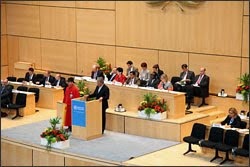
WHO/Jess HoffmanPRESS RELEASE: 'Sixty-third World Health Assembly unanimously adopts the WHO global Code of practice on the international recruitment of health personnel. Alliance members and partners applaud Member States. The Alliance 21/05/2010.

[Photo: WHO/Jess Hoffman. Dr Pierre François Unger, State Councillor of the Canton of Geneva, addresses delegates at the opening of the Sixty-third World Health Assembly.]

'Geneva, 21 May 2010 - In a historic move today, the Sixty-third World Health Assembly unanimously passed a resolution to adopt the voluntary WHO global Code of practice on the international recruitment of health personnel. With this step, the world's nations acknowledge the global dimension and complexities of the health workforce crisis and the interconnected nature of both the problems and the solutions.

'With this resolution, Member States commit themselves to the voluntary principles and practices for the ethical international recruitment of health personnel taking into account the responsibilities and rights of source and destination countries, other stakeholders, and those of the migrant health personnel themselves. The Code provides ethical principles applicable to the international recruitment of health personnel in a manner that strengthen the health systems of developing countries.

'A drafting committee was established on the first day of the Assembly and after three days of negotiations, stayed up till 4:30 am on Thursday, 20 May 2010 to seek consensus on a draft resolution that retained the principles and spirit of the Code while also representing a way forward for all countries.

'The draft was unanimously accepted at the tenth session of Committee A late evening on 20 May 2010 and brought long awaited joy and celebration to the many organizations and individuals, campaigners and professionals, institutions and Member States who had been working tirelessly since the last three years to see a meaningful and equitable resolution on the Code be adopted at the World Health Assembly.

'"The process was not always easy, but there was commitment from all Member States to see a resolution adopted. This helped to keep the process moving and the results are there to see" says Alliance Board member, Bjarne Garden, Assistant Director, Global Health and AIDS Department, NORAD, a member of the Norwegian delegation.

'"This brings to fruition the pioneering work seeded by the Alliance three years ago with the creation of the Health Worker Migration Initiative bringing together the Health Worker Migration Global Policy Advisory Council and WHO led team of technical experts. It is the result of the work of multiple stakeholders who have effectively rallied around together. The world is now a significant step closer to ensuring health workers are available and accessible to all", says Dr Mubashar Sheikh, Executive Director, Global Health Workforce Alliance.

'World Health Organization (WHO) has played a key role in coordinating the process. "The Code sets out a roadmap for implementation. Within 2 years WHO will provide guidance to countries on monitoring implementation of the Code, and then report to the Assembly on the progress against implementation. The Code is voluntary, but progress on implementation will be monitored and reviewed" explained Dr Manuel Dayrit, Director, WHO department of Human Resources for Health.

'Health personnel migration has been a clearly identified priority for the Alliance since its inception. During the First Global Forum on Human Resources for Health in March 2008, the Alliance endorsed the Kampala Declaration and Agenda for Global Action, which sparked broad interest in the creation of the Code.

'Progress on the code has been achieved as a result of consultations and discussions, particularly at all six WHO Regional Committees and national consultations, involving participation by a wide range of stakeholder groups. The UN ECOSOC meeting and the G8 Summit in July 2009, and the UN General Assembly in December 2009 had strongly supported and encouraged WHO to move forward in finalizing the draft code of practice. The 126th Session of the WHO Executive Board, January 2010, had discussed a revised draft of the Code and recommended that it be submitted to the 63rd World Health Assembly.

'At this momentous milestone, the Alliance and WHO call upon Member States and all its partners to reinforce its spirit of working together as they now gear up to implementing the code. The Alliance remains committed to facilitating the process and supporting sharing of information among Member States and all stakeholders.'

The Draft Resolution, dated 20 May 2010, is available here:
http://www.who.int/workforcealliance/knowledge/themes/migration/wha_A63_A_Confpaper_11.pdf

Key elements of the draft code (as described in The Lancet, 15 May) are:
  • Establishment of voluntary global standards for ethical international recruitment of health personnel, balancing rights and obligations of source states, destination states, and health personnel.
  • Promotion of coordination of national policies and international cooperation among states and their partners in health professions and civil society.
  • Recommendation that states strive to meet their domestic needs for health services with their own human resources through planning, education, and training for health workforce.
  • Recommendation that states ensure that international migration should have net positive effect on developing countries through technical assistance, support for health personnel training and retention, twinning of health facilities, and specialised technology and skills transfers.
  • Recommendation that states establish voluntary financial mechanisms to support efforts of developing countries to strengthen health systems.
  • Recommendation that states protect rights of migrant health workers through fair labour practices. In all terms of employment and conditions of work, migrant health personnel should enjoy same legal rights and responsibilities as domestically trained health workforce, without discrimination.
  • Recognition that health personnel have ethical responsibilities to cooperate with local authorities in interests of patients, health systems, and society.
  • Recommendation for national data collection and information exchange on health personnel migration, including establishment of national centre for information exchange, expansion and coordination of national research, and periodic reporting to WHO.
  • Promotion of compliance through periodic state reporting to WHA of measures taken to implement the code; and recommendation that WHA periodically reviews the code's implementation with input from non-governmental sources.
Allyn L Taylor & Lawrence O Gostin. International recruitment of health personnel. The Lancet, 375(9727)1673-1675, 15 May 2010
http://www.thelancet.com/journals/lancet/article/PIIS0140-6736%2810%2960596-X/fulltext?_eventId=login&&version=printerFriendly
(free access after free registration)


My source: HIFA2015 with photo addition

Sunday, May 9, 2010

International Journal of User Driven Healthcare (IJUDH) CfP

Dear Mr. Jones

In view of your work in patient-centered care, I’d like to invite you and/or your colleagues to submit a paper to this Special Issue of the new journal described further below and via the web link provided. I think our global readers would be very interested in your thoughts (and projects) on innovative ways to get relevant healthcare information into the hands of ‘users’ (both patients and providers), within the user-driven EBM paradigm, per below.

Please also share this call for papers with your colleagues.

Thanks for your consideration,

Susan Ross, MD


International Journal of User Driven Healthcare (IJUDH) Call for Papers

Editor-in-Chief:
Rakesh Biswas,
Center for Scientific Research and Development (CSRD),
PCMS Campus, India

Published: Quarterly

Call for Papers - Special Issue:

Submission Due Date: July 1, 2010
Special Issue On User Driven Healthcare and Evidence-based Medicine


Guest Editors:
Susan Ross, MD, FRCPC


Introduction

User Driven Healthcare (UDH) is part consumer-driven healthcare, part narrative medicine, and part Health 2.0. It stems from a concept of participatory healthcare whereby all stakeholders, enabled by information, software, and cyber-community, focus on healthcare value. But where does Evidence-based Medicine (EBM) fit into this framework? It is sometimes forgotten that EBM is a three-legged stool, comprised of the triad of evidence +provider expertise + patient preferences. In this EBM framework, provider expertise is needed to bridge the inferential gap between population-based evidence and the individual patient. And each patient's values and preferences should narrow that inferential gap further. But since the introduction of EBM nearly two decades ago, the primary focus of EBM proponents has been on Evidence, at the expense of patient preferences and provider expertise. Perhaps this is why the promise of EBM to foster the most efficient and high quality healthcare has not yet been realized.

Objective of the Special Issue

This Special Issue will focus on the following questions: Is the recent emergence of User Driven Healthcare really a new, post-EBM paradigm for healthcare, or just an overdue consideration of the other two legs of the original EBM stool? How might this trend affect all stakeholders?

Recommended Topics

Topics to be discussed in this special issue include (but are not limited to) the following:
  • Developing valid patient-level evidence using the Web
  • Evidence generation—clinical research strategies using social media and mobile technologies
  • Examples of UDH to a) help formulate the right questions to ask in EBM; b) develop answers to those questions; c) disseminate the answers to patients and providers with a need to know; and d) test the impact of UDH-generated Evidence on patient outcomes
  • Helping online patients sift the ‘wheat’ from the ‘chaff’—information management for patients in an EBM world
  • How to incorporate patient preferences and values into ambulatory care decision-making (i.e., into the 10 minute visit)
  • Measuring the impact of UDH on patient outcomes
  • Patient-level decisions vs. population-level evidence (bridging the inferential gap)
  • Pharmaceutical communication strategies using social media—impact on healthcare quality and costs in an EBM framework
  • Place of social media in EBM—patient and physician online communities
  • Practice of UDH vs. EBM around the world
  • Regulatory issues of evidence dissemination by industry using social media in healthcare Statistical and other evaluative methods to assess the validity and reliability of evidence developed using social media and mobile technologies
  • Trends in N-of-1 studies, and their relevance to EBM and UDH
  • Use of collective intelligence to solve healthcare problems for individuals and communities
Submission

Researchers and practitioners are invited to submit papers for this special theme issue on User Driven Healthcare and Evidence-based Medicine on or before July 1, 2010. Submissions received after this date will be reviewed for possible publication in subsequent issues of the journal. All submissions must be original and may not be under review by another publication. INTERESTED AUTHORS SHOULD CONSULT THE JOURNAL’S GUIDELINES FOR MANUSCRIPT SUBMISSIONS at http://www.igi-global.com/development/author_info/guide.asp. All submitted papers will be reviewed on a double-blind, peer review basis. Papers must follow APA style for reference citations.

All submissions and inquiries should be directed to the attention of:

Susan Ross, MD
Guest Editor
Email:sdross720@gmail.com