Showing posts with label philosophy. Show all posts

Thursday, March 10, 2011

Person centred care, wormholes, pesterers and care domains (ii)

Person centred care, wormholes, pesterers and care domains (i)

Mentor: Sorry my friend where were we up to?

Student: I am still puzzled as to how we can define and represent person centered care? Where does person centered care fit in h2cm (Hodges' health career model)?

The INDIVIDUAL-GROUP vertical axis places the person, the individual - at the top of the model. That could be a positive if we are thinking hierarchically, but shouldn't a model that is situated AND person centred be explicit and put the person at the center?

Mentor: This is a good question and you are right to ask it. As our previous discussions have illustrated our models are idealised and yet they should reflect the real world and experiences they seek to model and re-present for us:

Student: but in this case....?

Mentor: Well, not so quick...

As we noted the World's governments get the citizenry they deserve and vice-versa. If peace, political engagement, legitimate government and contentment are not a given but have to be earned then is person centred care any different?

Student: So, you are saying that peace, being a citizen, and mm... well-being I suppose are in a sense similar to person centered care?

Mentor: Perhaps?

Student: That seems quite a leap.

Mentor: Well your question prompts exercise - a certain gymnastics even - and with that a daily requirement we'll save this point for another time.

For now though... I know we don't necessarily need a precise definition of person centered care at the moment, but humour me and see what you can come up with in terms of this model of care. As you have mentioned it includes the INDIVIDUAL, the GROUP. And with the interpersonal and science domains the person's mind and body are literally in the frame.

Student: Well unless we are talking medical emergency then person centered care is about ensuring the individual is taken into account across all the domains of care.

That is - intra-interpersonal, physically - through the sciences, socially and politically. 
Oh - and spiritually too of course.

Mentor: So person centered or being person centered concerns domains of care?

Student: No. It's the content that matters. Take the interpersonal and myself as an example - what are my beliefs, previous experiences, writing skills and interests, my mood, disposition and attitude towards others. That only scratches the surface.

Mentor: I see. Can you go on from there...?

Student: Well I suppose each domain is visited according to various cues - and this is where context and situation come in. These supply the cues. They determine what is significant, what counts as information. For experienced nurses and health care practitioners this travel within and across the care domains comes as second nature.

Mm... I suspect that even if someone was not using h2cm explicitly their cognitive - conceptual movement could still be traced through the model, like passes on a football pitch.

Mentor: Very poetic! So if these care domains are being reflected upon does that mean person centered care is a consequence?

Student: Well I suppose it could if you take your mention of 'reflection' literally. Yes, picture the patient - the person - in the center of the h2cm matrix. We might even argue that our reflections place them there? Within the model what is the position of the person? If our deliberations could be measured - and practically that would be quite a task given patient engagement and dialogue - then is there an average across the domains? And is that the center - hence person centered?

Mentor: An interesting idea. And yet as you questioned initially the INDIVIDUAL in the model is at the top, at the top of an irregular continuum, so...?

Monday, February 7, 2011

h2cm: philosophy of science - analytical AND dialectical Refinetti, R. (1989).

"For centuries, philosophers have discussed whether knowledge progresses analytically or dialectically. In the Cartesian tradition of starting with simple concepts and then building up more complex concepts [4], the idea of science as a gradual accumulation of small pieces of knowledge was put forward by Auguste Comte [5]. This constitutes an analytical view of the progress of knowledge. On the other hand, Hegel proposed that knowledge grows as a whole, so that contradictions between opposing ideas are solved (and disperse pieces of knowledge are integrated) at each stage of the dialectical progress of knowledge [6]. This constitutes a dialectical view of the progress of knowledge.

The partial correctness of both the analytical view of Comte and the dialectical view of Hegel have been acknowledged for many years. Wisdom from both views can be found in the writings of many contemporary philosophers of science." Refinetti, R. (1989) p.583.


.... and can also be found within the structure and potential content of the Health Care Domains Model. Goethe in his own way(s) of seeing recognised the same...


Refinetti, R. (1989). Information processing as a central issue in philosophy of science, Information Processing & Management, 25, 5, 583-584.

Monday, January 17, 2011

Personal realities and in the media

Ordinarily I would be completely lost in tonight's Horizon - What Is Reality? at 9pm BBC2. I will be watching, but I won't be as lost as I have been.

Today I took a big step forward - sorting 'issues' that will allow me to purchase a new home. I ('we') also resolved the post-marital issue of pensions. This has proved a major reality re-orientation factor since July 2008. There is the old house to sell, but nonetheless real progress.

I am really looking forward to the NW England Drupal meet in Manchester on Friday. That's another reality to immerse oneself in - especially Drupal 7!

Tuesday, November 2, 2010

h2cm: Globalization, Accommodation theory and Relativism (Grayling, 2010)

From A.C. Grayling's Ideas that Matter, 2010, Phoenix.

Globalization: p. 235-236.
A more neutral account of globalization describes it as the process of making things known, done, available or possessed worldwide - such as Internet access, telecommunications, medical knowledge and benefits such as vaccines, transport technologies, political ideas, art and music, books and much besides.
Grayling also explains how the increased distribution associated with globalization is unequal, hence the sense of injustice that is felt resulting in protest.

The health care domains model is concerned with making things known - helping to make knowledge available on a personal, group and family level. This is no Mercator projection, not even Peter's projection but it is a global map.

Accommodation theory: p. 3-5.
Accommodation theory states that when people talk to each, they adjust their behaviour and manner of speech to take account of (to accommodate themselves to) the topic, the circumstances, and the other people engaged with them in conversation.

There are many theories to explain how we communicate and thereby model(?) ourselves, others and the world. Imagine a doctor's surgery and the morning's clinical consultations, it is easy to envisage the role that accommodation routinely plays. The one-to-one conversation (dialogue, argumentation, debate) can be extended, and viewed as the combined chatter, the whole series of multidisciplinary Q&A with the breaks (the silences when we are listening!). Accommodation theory has proved of value in multiculturalism, especially on policy concerning immigration and integration. p.5

The care domains provide an ethnoculturally neutral space (it could be argued) for the accommodations that are demanded in the 21st Century. 

Relativism: p.433.
There is a distinction to be drawn between moral or cultural relativism, on the one hand, and cognitive relativism on the other. The former concerns the difference between cultures, or between different historical phases of the same culture, with respect to religious, social, and moral values and practices, that is, with respect to what might be called the 'superstructure' of the culture's conceptual scheme. Cognitive relativism concerns the 'infrastructure', the level of basic beliefs about the world, such as that there are perception-independent, re-identifiable and individually discriminable objects or events, occupying space and time, interacting causally, and bearing properties of various kinds.
Much is said of the games that people play. Whether the care domains model provides a game board that can accommodate both the super- and infrastructural conceptual levels is open to question. In the health career model the infrastructure level concepts are light - as we find that they reside in the upper part of the model: perceived, individually discriminable (INTRApersonal) objects occupying space and time (SCIENCES) with mass, weight, inertia. ... The political domain prompts access to values and how these shape the total conceptual landscape(s), the conversations and silences that go on there ...

Wednesday, October 27, 2010

Fran Biley's video: Students on nursing theory

I came across this great video created by Francis Biley Bournemouth University through the Martha Rogers list:


Quite some time ago I wondered about having dummy - animated heads to carry out a dialogue. It is great to see how e-media forms and tools have developed now.

I have my own thoughts and ideas on nursing, perhaps over time I am drafting them in the bibliography and here on W2tQ?

Additional links:

Nursing theory resources SCIENCES links
Virtual Reality in Nursing: A dialogue from 1991
Nursing Telemachus and Computers: A dialogue from 1995

Wednesday, October 6, 2010

Lean machine(s): chasing the contexts

There is a perennial game in health and social care called assessment and evaluation: the game could also be called 'CTC' - 'chasing the context'.

Relativity lies not only in the realm of physics and philosophy.

When I say relativity I am referring of course to the influence and impact of a health and social care situation from the constantly changing perspective of each of several different players:
  • the patient;
  • carer;
  • nurse;
  • doctor;
  • manager;
  • medical ward;
  • community mental health team;
  • commissioner.
Usually, the context collapses to a specific problem (a situation) and the players set to solve a care problem presented by an individual -
  • a client, resident or patient;
and their -
  • relatives;
  • residential care home manager;
  • residential care home staff nurse and team;
  • community mental health nurse;
  • medical personnel.

Context directs, dictates, and shapes health and social care theory, practice, management and policy.

This relativism can also subvert, sublime, confuse and stymie plans, common sense notions, creativity, innovation and management directives.

Like a tide this relativity picks us up and re-figures, re-paints and shifts the location of everything - including measures and how they are used.

Context is all! - so the saying goes. But context never wholly reveals itself. For that is another situation, another context, another side, another coin.

For context there are key defining parameters (location, diagnoses, risk, need, physical, mental, holistic ...) all of these are couched or spring from time.

So, the game calls for us and the tide teases us to measure and evaluate. This coast is never clear, but how long is it now? Where are the pathways now? Where will they be again?

As we travel (and travail) to and from this context to that - thresholds are also altered: up and down and always around; the way of life and ..... .

Image source:
http://www.esd112.org/edtech/no_limit/rs_archive.cfm

Tuesday, July 20, 2010

The art and science of Serresian spin

To Michel Serres:
- the middle is a point of reflection, a point at which questions - the question - must be asked. In fulfilling the purposes of the health career model:
  • bridging the theory - practice gap;
  • facilitating holistic practice;
  • supporting (personal and group) reflection;
  • enabling curriculum development;
- the model's four domains are constantly (re-)visited in turn. Motion is constant. Conception - birth provides that initial impetus. Health status. Life - momentum. Centered on the person the movement is usually self-correcting, seeking balance. Health care. Questions and answers whether whole or in part follow, leaving a trail of care delivered and care planned. A record.

There is definite synergy between our use of the health career model, the dynamic quality and quantity of health and social care and Serres' description of the spinning top:
"The behaviour of the cone or the top is worth analysing. Throw this toy and describe, as Plato did, what happens. It is in movement, this is certain, yet it is stable. It even rests on its point or its pole, the more so as its movement is rapid. All children know this. But its rest is still more paradoxical. The top may move about, by translation, without ever losing its stability. To repeat, it can do so as long as it turns very quickly.


Even better, its axis may lean, take on an inclination, without putting the movement of the whole in too much danger. It may again rock, by nutation, oscillating around a mean location. This very ancient and quite childish machine is marvellously instructive.

First of all, it combines and the movements known and thinkable at the time: rotation, translation, fall, leaning and swaying. An integral model, additive, overcharged, yet simple. Second, and above all, it conjoins in a simple one-off experiment phenomena judged or presumed to be contradictory. It is in movement and rest, it turns and yet does not move, it rocks and is stable. The simplicity of a complexity, first and foremost, an additive machine; a synthesis of contradictions, beyond anything else. Now it may serve as a little model of the world, for a naive simple and local orrery. It quivers, at rest, it moves forward, turning, like the heavens, like the stars." p.28-29.

Michel Serres, (2000) The Birth of Physics, Return of the Model, Turba, turbo. Clinamen Press.


Image source: http://industry.bnet.com/technology/10002785/spinvox-or-someone-like-it-keeps-spinning/

Wednesday, June 30, 2010

earth, wind, fire, water AND the birth of physics

To begin - the health career model is concerned with space, structures and knowledge (care domains) built around two axes, plus the 'subjects' and 'activities' of health.

How we define and (so) divide space and accord that space salience amid changing contexts is critical to theory, practice and management and the models we subsequently derive:

... The dichotomy does not cut, it defines, it surrounds the closure of a limit, it delineates a boundary. Within the space thus enclosed like meets like. Or rather, conversely, the specific convergance [convenance] or identity, the assembly of the analogous, delimits zones in the disorder which are distinguished from each other. The earth is separated from the waters, air divides from fire. ... p.28.

Michel Serres, (2000) The Birth of Physics, Return of the Model, Turba, turbo. Clinamen Press.

water
earth
air
fire

Saturday, June 26, 2010

Nursing attitudes [towards patients ( and self { and ? } ) ]

In the past half-year there have been two discussions, that concern the nurse's attitude towards patients.

One was held on the nursing philosophy list in February:

https://www.jiscmail.ac.uk/cgi-bin/webadmin?A0=NURSE-PHILOSOPHY

"The patient is always right"

The other in May was on the mental health in higher education list:


"Insufferable' or 'Suffering' - a response"

Both provoked a similar response and debate. I have just reprised my post in February on the MHHE list and have copied it - with some revision - below:
<->

Patients are always a challenge in that they come in lots of 'varieties'.

This is why we recognise the need for individualised, person-centred care. One variety is trauma laden to which the full-complement of the multidisciplinary team must respond. These patients and *their* crises bring out the best in us in terms of the skills and knowledge, team work they force us to exercise.

Among the plethora of other varieties there are those who are viewed as 'problems'. Like the Pepsi ad of decades ago they are variously and pejoratively described as multiple attending, attention seeking, patience sapping, heart-sinking, time wasting, symptom preoccupied .... patients.

If I receive referral information, or heads up information on diagnosis that suggests the above what do I do?
  • Brace myself for impact?
  • Become task focused?
  • Share collective anecdotes in the staff room as a way to cope, unstress, inject some humour?
OR -
  • Avoid labelling them or use these labels in a re-constructive way?
  • Refuse to make gross assumptions
  • Look at the individual non-judgmentally, holistically, educationally, behaviourally
  • Believe I can make a difference (change is always possible [inevitable] )
  • Side-step being tripped by foibles, behaviours and blatant displays of -ve obstructive ... attitudes that offend 'me'
  • Enter their space and do my utmost to find room for manoeuvre?
  • As a nurse do go and seek out strengths and opportunities in the same way that Capt Kirk et al. go and seek New Life, New Civilizations..?
You may have an impossible lock to pick. In its most severe form this is (pejoratively) known as 'personality disorder', but the nursing challenge is there in all its personal and professional glory.

So. Listen.
Attend to this personal
/ under-the-skin \
slant.
Listen and Learn.

Be aware of the pit that continues to trap many people. The life chances - the health career - that they may have missed, took for granted, spurned and much more you (we) will never know about.

Do your job: nurse.

Monday, June 21, 2010

Philosophy of information empowers philosophy of care

The moral and ethical dimensions of nursing quickly become apparent to individual practitioners and professional associations. Philosophy in nursing boasts specific courses, journals and groups, for example:

International Philosophy of Nursing Society (IPONS)

Nursing Philosophy (journal)

International Centre for Nursing Ethics

Here on W2tQ, in papers and on the website I have stressed the importance of the health career model as a framework that can utilise information as a fundamental and potentially unifying concept.

Expanding on the post last week about the philosophers' magazine [tpm50] let's look at Floridi's piece on the philosophy of information (PI). The 50 ideas featured are each only granted two pages, but this has a definite philosophical equivalent twitter-styled appeal. On page 42 (- 43) Floridi notes that:
... PI possesses one of the most powerful conceptual vocabularies ever devised in philosophy. This is because one can rely on informational concepts whenever a complete understanding of some series of events is unavailable or unnecessary for providing an explanation. Virtually any issue can be rephrased informationally. Such semantic power is a great advantage of PI, understood as a methodology. ...

It shows that we a dealing with an influential paradigm. But it may also be a disadvantage, because a metaphorically pan informational approach can lead to a dangerous equivocation, namely, thinking that since any x can be described in (more or less metaphorically) informational terms, then the nature of any x is genuinely informational. (Luciano Floridi, 2010).
Admittedly Floridi's context is the position and status of PI as an emerging discipline within philosophy. As he notes the vocabulary while powerful lies in the discipline of philosophy.

Given my preoccupation with information, Floridi's observation above is a timely warning for me and the many nurses who in the past saw a concomitant risk that in adopting the nursing process, patients (and carers) would be processed. Ironically, this processing concerned information. The workflow - form and layout of the documentation - was prescribed. This is an old tale, with the nursing process being subsumed within the routine work of nursing. Perhaps though this also demonstrates a need for a new debate?

My interest in information is as a trope to explain the significance of the care (knowledge) domains that underpin Hodges' model. Crucially, though these can stand on their own as nursing philosophy issues. Joining the efforts of the nursing philosophers above, this can bring information and philosophy out of the academic realm to include a more practical and grounded variety of topics:

FROM: personal identity,
definitions and ownership of computer based records,
utility versus security of information (summary care record ...),
definitions of information (data, knowledge) - through
TO: patient information and patient informatics, ...
where is collective informatics# heading?

Taking Floridi's lead - which of the above .... are core nursing (health) information concepts (and not just freeloading info-masqueraders along for the ride)? Well, that is a question for a new community of scholars to decide?

Philosophy resources: Interpersonal care domain

#Collective informatics = all the claimed informatics disciplines combined?

Thursday, June 17, 2010

tpm50: the philosophers' magazine


tpm50 The best ideas of the 21st century

A 50th issue special (3rd quarter 2010) is on news stands. Perhaps as a warning (or lesson) for those managing or contemplating information projects - at No. 13:

Philosophy of information
Luciano Floridi

It looks as if there is an ironic subtext for ICT professionals here as the first idea featured is -

Conscious machines,
Igor Aleksander

And while the Floridi's Philosophy of information had me running to the till - it is followed by:

Non-critical thinking,
Nick Fotion

This is a 128 page little gem at £5.99 $US 9.99. More to follow me thinks. ...

Tuesday, April 13, 2010

Reading the signs - Idealised Care

Hodges' model
With the axes of the health career model labelled and the care domains - that fall between - identified, what can we read into and from the health career - care domains - model?

What basics of care and caring can we find there, what assumptions can we jump upon?

Here is a list ... (which also illustrates how the model grows with the learner) :)


  • Health, well-being and social care are not declared in the face of the model, this suggests the model is high-level - generic.
  • Health care (here) has at least seven disciplinary degrees of freedom:

    • Sciences (biology, physics, chemistry)
    • Politics
    • Psychology
    • Sociology
    • Spirituality

  • Health and social care theory and practices are reductive.
  • Health care involves the traversal of space - distance.
  • Health and social care has the potential to be depersonalising and alienating.
  • Health and social care is simple and complex.
  • The environment is inherent within the model in its varied forms.
  • There is a moment of imbalance within the INDIVIDUAL - GROUP.
  • Context is essential as a means to situate care (co-ordinate in an 'x','y' sense).
  • The means is provided to situate the care context in a person-centred way.
  • This model provides a template for personal and group reflection (shallow or deep).
  • The model is open in terms of the final content, the content as expressed in care approach, philosophy, discipline, description (concepts, problems, priorities, strengths, a 'mash-up') is not dictated.
  • In acknowledging the existence and primacy of the individual (located at the top so - must be important), the model provides a (potential) focus and vehicle for individualised, personalised, person-centred care.
  • Whilst individualised care is at the center of care theory, practice and management, it cannot be defined purely by virtue of the INDIVIDUAL-group axis and the claim of an associated INTRA-INTERPERSONAL care domain.
  • The individual must also be considered as a POLITICAL entity, a citizen, a legal entity that falls under the auspices of human rights. As such the individual is someone who can (or has previously) expressed their choices, wishes as to their health, care, well-being, best interests.
  • Being an INDIVIDUAL within the family of humankind - 1 of some 6.x or > 7 billion - this person is unique and deserving of highest quality care, dignity and respect that should be accorded to all people.
  • Health and social care whilst organisationally distinct (POLITICAL - POLICY) are to the INDIVIDUAL and carers (GROUP) concurrent, transparent and ideally integrated activities.
  • Physical care (SCIENCES) can be, and is, defined in mechanistic terms; for example, time (objective), events, place, outcomes, observations / data (discrete, quantitative).
  • Physical care is hence primarily objective.
  • Emotional INTERPERSONAL care can be, and is defined in humanistic terms; for example, time (subjective), communication, responses to events (behaviour), feelings, beliefs, relationships (SOCIAL), expectations, fears, observations / data (subjective, qualitative).
  • Physical care, emotional care is often mediated through the SOCIAL domain and the group - the family unit.
  • Since this model indicates an initial structure and content the model is of potential use as a reflective resource for novice through to expert.
  • The model is generic and as such not limited to health and social care.
  • Such is the generic nature of the model it can support all learners in lifelong learning.
  • The Spiritual is not there: it is ineffable. It is everywhere, everything, every'I' and everynow.
  • Time is inherent in several forms within health and social care.
  • The economics of health care is infused to all the domains, notably in the first instance to the SCIENCES and SOCIAL domains.
  • The economic effects upon the individual in a humanistic sense, may be remote, but is inverse in terms of its impact.
  • The model reinforces dualism: mind - body (but cognitively innoculates also).
  • In highlighting boundaries, dichotomy, limits the model can stress the need for integration.
  • The model suggests an antipodean fracture in relationships*: the patient and clinician (across physical care and mental health) inhabit the Northern hemisphere; while the carer (public), manager and policy maker the Southern.
  • Health and social care is grounded in human communication (and that which is mediated).
  • 'Sense making' must be a key issue in health and social care.
  • Given the scope of the model, technology must be making a major impact across all fields of health and social care.
  • The model can simultaneously represent the SOCIO- and the -TECHNICAL.
  • A great many (potentially - all) values and standards are inherent in the model.
  • This model can be represented using many media.
  • This model is open to the Management Consultant's delicacy alphabet soup, i.e. using letters to represent approaches / methods, e.g. 4P's, 4C's.
  • Health and social care can also be described holistically.

*Clearly, given the relationships and issues that arise this bears further examination and discussion.


This list is subject to revision - addition.

Image source:
http://en.wikipedia.org/wiki/File:Antipodes_LAEA.png

Tuesday, March 30, 2010

Hodges model: The realm of the Centaur...?

I've rather messed about here before with ideas for the new website, banners and graphics. In reading I've switched from SF to Ken Wilber, who with David Bohm I have intended to read for many years.

In Wilber's book No Boundary I found a gift of an iconic image, as in health and social care we constantly strive to achieve integrated and holistic care.


Much of my day-to-day work involves mind-body : body-mind and the suffering between.

In No Boundary we read about the Centaur:
Let us return to the level of the total organism and continue with the story of the growth of the spectrum. At this level, the individual is identified solely with her organism, existing in time, in flight from death. Nevertheless, she is at least still in touch with her entire psychophysical being. This is why we usually refer to the level of the total organism by a simpler name: the centaur. A centaur is a legendary animal, half human and half horse, and so it well represents a perfect union and harmony of mental and physical. A centaur is not a horse rider in control of her horse, but a rider who is one with her horse. Not a psyche divorced from and in control of a soma, but a self-controlling, self-governing, psychosomatic unity. p.72

Related posts:

Holistic care and 'where' it means....

20/20 vision minus 1, 2, or 4 blind spots....

Physio-Political ... musings, songs and dances...

Additional links:

Philosophy, Ideas, Creativity links: Interpersonal domain

"The constant rain of time that is life peppers space with relevance." *


*In reading Wilber it looks like I will have come up with something else...?

Ken Wilber (2000) No Boundary: Eastern and Western Approaches to Personal Growth. Paperback / Shambhala Publications, ISBN 978-1-57062-743-9.

Image source:
http://ancientcoinsforeducation.org/gallery2/d/3116-1/CentaurGreekPotteryRed.jpg

Tuesday, March 2, 2010

Person-centred care and semantic inflation

Time laughs at us, with us and has the last laugh. If you are ever complacent and by virtue of your years you venture to think to yourself:

Well we've been working on this now for 20-30 years look at the progress we've made. ...

Time is always there to remind you:
Hey, just who are you trying to fool?
You are a lifelong learner!

The number of personnel and services that describe themselves as person-centred is an ongoing theme of so many CVs, policies, SLAs, commissioning and consultant's presentations and lectures. ...

Whether in a ward, service, or organisation's philosophy, person-centred is a term that is being diluted to the extent that semantic inflation devalues what is supposed to be the main currency? Or are we admitting that this is the cost of the political games that people play? Whatever your view, there are insights of progress won, but also reminders on how much remains to be done.

Health and social care being multicontextual demands the existence of multiple currencies. One additional currency begs that we compare A, B, C with the evidence base.

If this is the crucible of our person-centred times then what is burning?
  • Nursing ethics?
  • Nursing education?
  • Idealistic aspiration? (Yes, we will get there!)
  • New Age incense?
  • Policy initiatives?
  • Funding allocations?
  • Nursing activism (Or, are there any balls in the house)?
  • Service infrastructures?
Although the media temperature is rising here in the UK, as health, itself economically recumbent is moved to ICU being so politicised; the Francis Report provides evidence of a dire lack of person-centred care. Recalling my basic nurse training: what can be more person-centred than ensuring that a patient has the necessary fluids and diet?

For women who suffer a miscarriage - where should they be nursed as debated in today's Guardian newspaper? What is person-centred care in maternity and gynaecology services?

In-patient provision and transitions from child-youth-adult provide other opportunities and major challenges for health and social care to demonstrate their person-centredness.

There are so many ways to be person-centred, so many levels, some may even be contradictory(?).

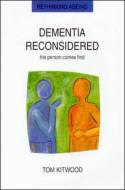
book cover
I wonder how many of those people highlighted in the Francis Report also had a form of dementia - whether diagnosed or not? Personhood and the need to acknowledge and sustain the person are not new.

Even if a service is person-centred in terms of the environment, meal choices, therapeutic options, belongings, personal space, proximity to home and relatives ... the crux at the center is the attitude of staff, and their having the time and space:


"to be"

person-centred

Additional links:

Mumsnet

Atkins, L. (2010) NHS 'must lessen trauma of miscarriages' Parents web forum Mumsnet calls for new code of practice to help women who lose their babies, The Guardian, Tuesday 2 March.

Image source:
http://drugsreference.co.uk/books/books.php?cat2=Caregiving

Friday, February 19, 2010

'Problem patients?' 2 - Appease me do (not)

Many of the aspirations of nursing are just that - aspirational.

Appeasement and other similar 'power' associated concepts helps explain some of the appeal of Hodges' model - with its inclusion of a POLITICAL care domain. The needs of the ONE (interpersonal care domain) are diagonally opposed by the needs of the MANY (political care domain).

Just because I may approach someone (*evidently*) abusing medication / alcohol, over-eating, risk taking ... does not mean I am prepared to continue to nurse them and hence support them in that behaviour. Attempts to engage can be made and (must be) documented, as subsequent referrals and care will build on those care encounters. There is a marked difference between those individuals above who are often socially excluded, risk takers and people who are preoccupied with their health and mental health state. (Are such people stuck in the 'sick role?) Such patients may well seek new drugs and then instantly question the medication they are taking, never satisfied, they may query their care record and care while in hospital by virtue of their personality and anxieties.

I can reject negative behaviours and attitudes, but not the person. As a member of the health care team I can explain clear terms for future engagement should the patient wish. At the end of the day we constantly review: do they have mental capacity and to what extent does their behaviour present a risk to themselves, or others...? There is also a role for specific care management to be effected, to screen and prevent people reaching emergency services when this is repeated and unnecessary. The combination of some conditions such as long term respiratory problems and anxiety can create acute management problems, both for the individuals concerned, their family carers and care providers.

People do have choices to make, and so must take responsibility for how they exercise those choices.

Crucially this also needs to be explained to referrers - e.g. general practitioners / family physicians. For effective care management the inclusion of paramedic, crisis, social and intermediate care services in care management communication and coordination is also essential.

So, there is absolutely no need for a "current model of appeasement based care".

(This is a wind-up - surely? If not I am available for career advice.)

Yours truly and the patient's (even if it hurts),

Peter Jones

'Problem patients?' 1

Nurse Philosophy list

Wednesday, February 17, 2010

'Problem patients?' 1 - Wimps and space to care

I responded to a mail list discussion around 'problem patients' which began with the following main points:
  • a relatively new nurse
  • surprise that a significant minority of (my) patients are pathological wimps;
  • even prior to seeing them they can often easily be spotted by examining their medical records;
  • for example, I frequently notice that wimps have an obscene (and often downright odd) amount of special meal requests;
  • current nursing philosophy encourages nurses to be endlessly supportive of wimps. i.e. to follow the often demonstrably wrong idea that "the patient is always right.";
  • IMO nurses who claim they benefit such patients using the current model of appeasement based care are co-dependent personality types who enjoy feeling needed more than they enjoy actually helping people.
My first response is copied below with some additional points a further post will follow:

Patients are always a challenge in that they come in lots of 'varieties'. This is why we recognise the need for individualised, person-centred care. One variety is physical trauma laden to which the full-complement of the multidisciplinary team must respond. These patients and *their* crises bring out the best in us in terms of the skills and knowledge, team work they force us to exercise.

Among the plethora of other varieties there are those who are viewed as 'problems'. Like the Pepsi ad of decades ago they are variously and pejoratively described as -

multiattendin, attentionseekin, patiencesappin, bedblockin,
buzzabuzz-buzzin, heartsinkin, timewastin,
symptomfindin, carenumbin

....
patients!

If I receive referral information or heads up information on diagnosis of a 'tci' (to come in) that suggests the above is on the way, has arrived or worse "is on your caseload" - what do I do?
  • Brace myself for impact?
  • Go off sick (suffering loss of job satisfaction)?
  • Become purely task or disease focussed, give up on effecting +ve change and improved outcome?
  • Share collective anecdotes in the office - staff changing as a way to cope, de-stress, inject some humour?
OR do I -
  • Avoid labelling them, or use these labels in a re-constructive way?
  • Ask why are they 'who' they are?
  • Gaze into their 'life history' and help them learn from it?
  • Refuse to make gross assumptions, even based on previous experience with client - patient?
  • Look at the individual wholistically - socially, educationally, behaviourally?
  • Believe you can still make a difference (be the fly-half you can be and play ball)?
  • Side step being tripped by foibles, behaviours and blatant displays of -ve obstructive ...... attitude that offend 'me'?
  • Enter their space and do my utmost to find room for manoeuvre (this is the hardest test)?
  • Speak to my manager(s) very tersely about protecting 'me' as a scarce resource and shout "OK where the hell is the gate keeper!"
  • Or, as a nurse do you boldly go and seek out new strengths and new opportunities in the same way that Kirk, McCoy, Spock et al. (2264) go and seek New Life, New Civilizations...?
You may have an impossible lock to pick (in its most severe form this has become known as 'personality disorder'), but the nursing challenge is there in all its personal and professional glory. Address this personal - under-the-skin - slant - seek supervision. Be aware of the pit that some people fall into. The trap for some people with life chances they may have completely:

missed, never had, were stolen, denied,
took for granted, spurned,
totally - wasted.

Around the pit is the zone of judgement, but beware it is a singularity (no perspective) and very slippery.
  • Otherwise go do your job: Nurse.
Nurse Philosophy list

Reference:

Kirk, McCoy, Spock et al. (2264) The Caring Imperative, To Boldly Go..., Four Quadrant Galactic Care Journal, Integrated Galactic Care Publishing Inc. itess-cube: 1701u-care4mesafelyandnicely

Monday, February 1, 2010

Sir Terry Pratchett: 34th Richard Dimbleby Lecture - Shaking Hands with Death

Terry Pratchett The Guardian

I watched Sir Terry Pratchett's Richard Dimbleby Lecture (I am not yet sure if this will be available on iPlayer?). The issues are already well recognised, much debated and provide a constant tap on the shoulder for us all:

Although the poll numbers are small
there is a definite shift afoot.

From the BBC:

One of the world's most popular authors gives the 34th Richard Dimbleby Lecture from the Royal College of Physicians in London.

Sir Terry Pratchett announced in 2007 that he had been diagnosed with a rare form of early-onset Alzheimer's disease. In his keynote lecture, Shaking Hands with Death, he explores how modern society, confronted with an increasingly older population, many of whom will suffer from incurable illnesses, needs to redefine how it deals with death.

The acclaimed creator of the bestselling Discworld series, he is the first novelist to give the Richard Dimbleby Lecture. His books have sold more than 65 million copies and have been translated into 37 languages.

<->

I realised in listening to Sir Terry that although I usually apply socio-technical in an informatics context, the term is of course equally applicable to the debate surrounding assisted suicide, or assisted death as Sir Terry prefers to call it. The quality of (our social) life is lost in the beep, buzz, hum and scan of hyper-technical health care.

It is as if the technology of health care is producing relativistic effects. Instead of the travellers being explorers heading for stars at near the speed of light; they are travellers cast adrift within a long term chronic disease that cuts them off from time, place, person, those they love and - for Sir Terry - choice. ...

This debate will run on ...

Photo source: The Guardian

Wednesday, January 13, 2010

'situated' in Hodges' model #2

So, Hodges' model is person-centred and situated
- a conceptual springboard for all.

In the 1970-80s the nursing process challenged task-based care.

Ever since we have stressed individualised, personalised care and now today self-care.

Interpersonal and communication skills are central to nursing theory,
practice, management and informatics.

In Hodges' model the individual is the primary focus*.

The science and art of nursing
is predicated upon the
nurse - patient
relationship.

Situated = 'Its a duet' (anagram)


*Inclusion of the 'group' in the model also facilitates
consideration of relatives, parent-child, family, community and populations.

Tuesday, January 12, 2010

'situated' in Hodges' model #1

I'm not exactly sure how many times I've cut and pasted the paragraphs that introduce Hodges' model as person-centered and situated. Quite a few!

Thanks to the HIFA-2015 list I realised last week that there is no tag for 'situated' on W2tQ. Well, this post corrects that omission, but what does situated mean in Hodges' model?

Here is a definition c/o Google:
  • situated/s'ɪtʃueɪtɪd/
    Synonyms:
    • If something is situated in a particular place or position, it is in that place or position. ADJ adv ADJ v-link ADJ prep
      ...
Related phrases
  • If you situate something such as an idea or fact in a particular context, you relate it to that context, especially in order to understand it better.
    ...
Hodges' model is based on the belief that health and social care are multicontextual. Without wishing to substitute one term for another context and situation are inter-related and bear closer examination here on W2tQ.

Hodges' model prompts the user to consider that the person (-at-the-center) of care is simultaneously residing within four primary situations or contexts (five - if we include the spiritual aspects). Veterans and new recruits appreciate from the dizzy heights of the model, how quickly we find complexity in the multiple contexts that exist in health and social care. The many perspectives and views that must be taken into account to achieve safe, integrated and holistic care. Together with the above there are other definitions of relevance to scholars, champions and users of Hodges' model:
located: situated in a particular spot or position; "valuable centrally located urban land"; "strategically placed artillery"; "a house set on a ...
wordnetweb.princeton.edu/perl/webwn

In artificial intelligence and cognitive science, the term situated refers to an agent which is embedded in an environment. ...
en.wikipedia.org/wiki/Situated

Located in a specific place; Supplied with money or means
en.wiktionary.org/wiki/situated
The first definition about location is important as Hodges' model puts the person at the center. It is from there that the care domains are considered in turn and revisited as required. Hodges' model provides a locus around which care activities can be placed. Usually we view self-centeredness in a pejorative way. When you think about it though this is precisely what is needed to achieve person-centered care. In this case we need something that constantly re-centers - reorientates the subject(s) and agent(s) of care.

The second definition which looks to A.I. for inspiration is relevant as the concept of embodiment, embeddedness already has academic form* as a means to explore self-centeredness. Not only is the individual embedded in a (the) situation, but the carer (formal - informal) must also reside there and share to an extent the experience, if empathy, rapport and communication are to arise.

That final definition can be utilised due to the inclusion of means. People have skills, strengths and coping strategies and this sense of situated rings very true at present, with the emphasis on recovery, staying well, relapse prevention and adjusting to what may be permanent change. People also need knowledge as a means to maximise their health and well-being, which takes me back where I started with Health Information for All by 2015.

So, amid all the complexity, over-arching infrastructures, policies,
debate (and definitions!) it is refreshing that as I revel in the
scope of Hodges' model - two axes, four domains,
its holistic bandwidth... I can find the
word 'situated' planted
firmly
at the model's
center.


* Ref:
Paley, J. (2004) Clinical cognition and embodiment, International Journal of Nursing Studies, Volume 41, Issue 1, Pages 1-13.

Image source - with thanks: Ariel Bravy - http://www.arielbravy.com/photoblog/
http://www.arielbravy.com/photoblog/images/20060719214447_glenn%20x%20millenium%20park.jpg

Thursday, November 19, 2009

World Philosophy Day 2009

The world's population really needs the skills (literacy!) to balance arguments and debate issues. Today being World Philosophy Day, 19 November 2009 we can see this need as global events re-frame our words. For decades now some of the world's cities - capitals have become synonymous with fevered political debate, equality, equity, poverty, power.... 'Copenhagen' is the latest example, stressing the need for informed argument and rationale thinking on an individual and group level, as the UNESCO introduction reveals:
Ever since its inauguration as a “Philosophy Day at UNESCO” in 2002 and particularly since its institutionalization in 2005 as a “World Philosophy Day”, this celebration of philosophy has inspired much enthusiasm. With its aim to bring philosophy closer to everyone, academics, students and the general public alike have all shown great interest in this activity that offers new opportunities and space for philosophical reflection, critical thinking and debate.
My previous studies comprised a joint honours degree in computing and philosophy, which may account for the appeal of Hodges' model and the reflections here on W2tQ. As mentioned previously, in the 1990s I wrote a dialogue (of sorts):
The aims of this 'dialogue' are threefold. First, simply to explore through the minds and voices of two ancient characters, contemporary nursing informatics and telematics issues. Secondly, to test the viability of the dialogue as an alternative format to the usual academic paper. And thirdly, to introduce unfamiliar readers (students?) to 'the' master of the dialogue form - Plato.
Readers may (hopefully) be stimulated to seek out Plato's works, which are freely available in affordable paperback editions. 'The Last Days of Socrates' is recommended as a starting point. Plato captures in the dialogues the technique employed by Socrates, that still bears his name - 'Socratic questioning'.
As health professionals search for ways to reassert values amid unprecedented technical and social change, philosophy is once more on the agenda. This attempted 'dialogue' has two protagonists. Telemachus, who is in name from Homer's Odyssey and other Hellenic literature. The name appeals to me here due to the study of 'tele'-matics, a key branch of informatics research.
Epictetus (50-120A.D.) was a philosopher of the stoic school. Sometimes we find unexpected connections in things, as with Epictetus: nursing - health - ethics/values - philosophy - Enchiridion (Manual) health - how to live ones life - leadership - 3,000 drachmas paid for E.'s lamp after his death - Florence Nightingale - nursing!
Telemachus is a student of the Academy established by Aristotle, starting his third year of nurse training. Epictetus is staged as a professor, a member of the faculty for health. With apologies...

There is also a philosophy listing on the INTER-INTRAPERSONAL links page. One initiative here in the UK which I must admit I have not attended thus far is Philosophy in Pubs. Many colleges also do courses were you do not necessarily have to sign-up for the whole deal - that is exams - but you can still enjoy what is a marvellous subject. I remember a lady of some 70 years who did just that with literature, she also beautifully shredded my unspoken thoughts on Sylvia Plath's Ariel and other works. So do go and check what's happening in your area.

Despite the significance of today it is troubling that the existence and value of university philosophy departments can be thrown into doubt as recently as March this year. I must check what happened in Liverpool? And also wonder what there is to learn from Eastern and African philosophy?