Showing posts with label books. Show all posts

Wednesday, January 5, 2011

2011... looking ahead: Line of sight - Lines of insight

LINE OF SIGHT:

LINES OF INSIGHT:

Fractal Drum


Image sources:

Wilkinson, F.J., Monkhouse, H. R. (1967). Maps and Diagrams; Their Compilation and Construction [Paperback], Methuen & Co Ltd. Intervisibility, Line of sight. p. 125 [scanned].
(Book purchased in Mevagissey, Cornwall, Hurley Books July 2010)

Fractal drum. Lines of INsight: http://classes.yale.edu/fractals/panorama/ManuFractals/FractalDrums/FractalDrums.html

Health and social care - listen!

Wednesday, November 3, 2010

Drupal musings 19: DrupalCamp Edinburgh, Panels, another prize book! and a 'mu'.

DrupalCamp Edinburgh was just one day, but a Drupal drenched day. So, camping can be fun even when it rains - community spirit and ethos, tips and things you never knew.

The first session on PHP namespaces with Jonathan was on the technical side, but this is a topic to watch for Drupal 8.

Up RPC - upgrading was also technical in the sense of being for people with sites to upgrade. Joachim went through the process from Drupal 5 to 6.

Drush - the DRUpal SHell (Mac) was presented by snufkin and with the frequency Drush crops up at Drupal events, inc. NW England it's a mu - must use.

A question was raised around multimedia in Drupal, this centred upon images.

The afternoon was built around Chris Muktar's session on WikiJob. Chris described the site's birth, growth and move to Drupal. Wikijob utilises the PressFlow distribution of Drupal optomised for performance and scalability. What was fascinating here were the insights into the use of Pantheon and Amazon Web Services. The good news for Chris and WikiJob is that hosting costs are dropping month-on-month while the lessons: you need to know what you're doing and AWS is self-service.

Providing for mobile users came up and here I was actually able to contribute (well sort of) with my notes from Copenhagen and Martin Joergensen's session.

At the end there was a prize draw. I won another book! Drupal 6 Panels Cookbook, Bhawin (Vin) Patel, Packt. Having read this there's no doubt that combining Views and Panels packs some punch, especially as in Chapter 10 a travel website is created and the recipe uses the PressFlow distribution. This chapter also uses the Location and GMap modules, which I am currently looking at. Since first hearing there were modules called Panels, Views and Context I've automatically attributed h2cm related functionality to them. The care domains are 'panels'. Organic Groups, another example has proved quite different to what I thought and I only learned that this summer (that's why using really is learning). What the book brings home - without picking up the shovel - is the way these modules leverage each other.

At 10am when everyone first met with two sessions scheduled with the rest of the 10-5 day a blank I worried: 200 miles! (I didn't attend, but the morning also saw Addison Berry of Lullabot running a "Beginners Track"). My faith deserted me only for a moment. Great job Duncan and all, if there is another let me know!

Tuesday, November 2, 2010

h2cm: Globalization, Accommodation theory and Relativism (Grayling, 2010)

From A.C. Grayling's Ideas that Matter, 2010, Phoenix.

Globalization: p. 235-236.
A more neutral account of globalization describes it as the process of making things known, done, available or possessed worldwide - such as Internet access, telecommunications, medical knowledge and benefits such as vaccines, transport technologies, political ideas, art and music, books and much besides.
Grayling also explains how the increased distribution associated with globalization is unequal, hence the sense of injustice that is felt resulting in protest.

The health care domains model is concerned with making things known - helping to make knowledge available on a personal, group and family level. This is no Mercator projection, not even Peter's projection but it is a global map.

Accommodation theory: p. 3-5.
Accommodation theory states that when people talk to each, they adjust their behaviour and manner of speech to take account of (to accommodate themselves to) the topic, the circumstances, and the other people engaged with them in conversation.

There are many theories to explain how we communicate and thereby model(?) ourselves, others and the world. Imagine a doctor's surgery and the morning's clinical consultations, it is easy to envisage the role that accommodation routinely plays. The one-to-one conversation (dialogue, argumentation, debate) can be extended, and viewed as the combined chatter, the whole series of multidisciplinary Q&A with the breaks (the silences when we are listening!). Accommodation theory has proved of value in multiculturalism, especially on policy concerning immigration and integration. p.5

The care domains provide an ethnoculturally neutral space (it could be argued) for the accommodations that are demanded in the 21st Century. 

Relativism: p.433.
There is a distinction to be drawn between moral or cultural relativism, on the one hand, and cognitive relativism on the other. The former concerns the difference between cultures, or between different historical phases of the same culture, with respect to religious, social, and moral values and practices, that is, with respect to what might be called the 'superstructure' of the culture's conceptual scheme. Cognitive relativism concerns the 'infrastructure', the level of basic beliefs about the world, such as that there are perception-independent, re-identifiable and individually discriminable objects or events, occupying space and time, interacting causally, and bearing properties of various kinds.
Much is said of the games that people play. Whether the care domains model provides a game board that can accommodate both the super- and infrastructural conceptual levels is open to question. In the health career model the infrastructure level concepts are light - as we find that they reside in the upper part of the model: perceived, individually discriminable (INTRApersonal) objects occupying space and time (SCIENCES) with mass, weight, inertia. ... The political domain prompts access to values and how these shape the total conceptual landscape(s), the conversations and silences that go on there ...

Monday, October 18, 2010

Drupal musings 17: PHPNW 2010, HTML5, DrupalCamp Edinburgh

PHPNW 2010 on the w/e 9th - 10th October was well worth attending. Sessions for me after the keynote included:

Let your toolchain set you free

Debugging – Rules and Tools

The curious case of php|architect

Designing HTTP URLs and REST Interfaces

All the sessions where very informative, but the latter proved the most interesting. I noticed REST interfaces kept coming up at the Ruby conferences in '08 and '09 and also in reading about Ajax. So David Zuelke's session was very interesting both with his critique of how REST is applied (twitter) and his humour. I look f/w to the videos appearing.

A dinner date with friends meant I had to leave early and so I missed the prize draw. The past week started with a smile when Emma Parker, PHPNW10 Events Team emailed to say I'd won a book in the prize draw. Last Thursday the book arrived:

Pro HTML5 Programming

Magic! Thanks to the conference team and Apress.


I have just learned about DrupalCamp Edinburgh on the 30th and have registered.

Thursday, September 9, 2010

Gardner's 5 Minds for the Future (and the Question)

In order to pursue post graduate study you need a project, which demands a question. Formulating a research question is central. I wonder however whether there remains a bias - hard sciences vs humanities (and triangulation) - towards a class of questions that are closed and so can be answered in X-words : Y-time : with Z-funding? Thereby passing through the necessary academic hoops. Of course I realise that if there are no constraints then chaos would ensue. I just wonder if the journey (creativity, discovery ...) might be lost for the sake of assuring the end product?

My questions (apart from 'beware reflex moves') tend to be framed in broad terms. You could say that as yet I am not disciplined (specific) enough to come up with a question that passes "GO!"

In Howard Gardner's Five Minds for the Future the issue of educational programmes is raised and I read the following:
The second antidote entails the creation of educational programs directed specifically at certain individuals of promise - for example, leaders of tomorrow. Chief executives and general managers are expected to be able to see the big picture - to look beyond their own background and specialization; to understand the various components in their organization or constituency; to think systematically about what is working, what is not working, and how goals can be more effectively achieved. ...

Other individuals - for example, those exhibiting a "searchlight" or "bricoleur" intelligence - might be attracted to such programs as well. They would make use of their enhanced skills even if they do not occupy explicit leadership roles. Perhaps, as educator Vartan Gregorian has suggested, we need a specialization in becoming a generalist. p.75.
Gardner, H. (2008) Five Minds for the Future, Harvard University Press.

Thursday, September 2, 2010

Drupal musings 13: Packaged care and modules

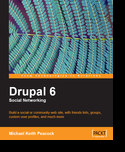
Packt book cover 'Social Networking'Although I do not need to sit at the front for presentations anymore, I did so at Drupalcon as the electricity plugs were few and forward. There was a bonus. Being in the right place... I picked up a free book c/o Packt Publishing who were among the exhibitors and valued sponsors. The book is Michael Peacock's Social Networking (don't panic I'm not going to review it!). Since returning from Copenhagen I've been using Drupal 6 and 7 on a daily basis. Checking just what some of the key modules, such as Taxonomy, Taxonomy Manager, and Groups have to offer. What are the configuration options and how well do modules integrate?

In the book Michael lists the Drupal modules he relies on to create a site worthy of the book's title. He explains that many modules are themselves 'packaged' for example - the Activity module:

Activity: Activity
Activity: Activity history
Activity: Comment activity
Activity: Node activity
Activity: OG# activity (#organic groups) p.140

This highlights the multifunctional capability of modules which leads me to wonder* about what functionality might be found in future modules:

Intrapersonal: Communication
Intrapersonal: Mood
Intrapersonal: Cognition
Intrapersonal: Diagnosis
Intrapersonal: Interests
Intrapersonal: Risk
Intrapersonal: Skills-Education

Sciences: Observations
Sciences: Physical attributes
Sciences: Mobility
Sciences: Nutrition
Sciences: Diagnosis
Sciences: Physical safety

Sociology: Relationships
Sociology: Ethnicity
Sociology: Interests
Sociology: Religion
Sociology: Carer assessment

Political: Marital status
Political: Employment
Political: Benefits-Welfare
Political: Capacity
Political: Autonomy
Political: Mental Health Act status

Further news:
The new PC is ordered 10-12 days until its arrival. Yes, I could go DIY, but I'm busy.

This Saturday evening I will have some 4-5 hours with the client of the basic Drupal 6 site. Very much looking forward to that. Must remember KISS!

*Not necessarily an actual proposal!

Tuesday, August 24, 2010

Care design: c/o DDC Copenhagen

On Monday afternoon I explored the city of Copenhagen walking to several sites - the Tivoli Gardens, the Tycho Brahe Planetarium and other parts of this lovely city. I ended up spending a couple of hours at the Danish Design Center.

Like my occasional visits to London's museums, the DDC although very small provided a couple of pearls. One display across a wall upstairs outlined the main forms of design theory and practice:
  • The USER as designer
  • TECHNOLOGY in the design process
  • New MATERIALS and smart design
  • NATURE
  • SOCIAL design and CARE design
  • GREEN design
  • ART design
  • EMOTIONAL design
  • REPLACEMENT due to changing fashions (built in obsolescence!)
  • SERVICE and CONCEPT design
The following text was displayed to describe SOCIAL design and CARE design:
The population pyramid has changed shape. The working-age group is shrinking compared to the group of people of retirement age. In addition, there is the large segment of the so-called weak - particularly in the 3rd world. Thus, social design and care design will be big and important design areas in the future, because the solutions will seek to strengthen the health care sector and improve conditions in the 3rd world and for underpriviledged people in general. Parameters such as increased dependency, quality of life and dignity are crucial elements in solutions relating to social design and care design. DDC display; August 23 2010.
Many themes come together here. Some are represented in the tags below. Care design is much more than what we might consider as 'standard design' aspects, such as; user interface [UI] and user experience [UX]. Care design is even more dependent upon user engagement.

There is another dependency that as yet has a '?' in the data entry box.

Care design needs coherent forms of personal, social and civic responsibility. These are yet to emerge as think tanks, governments and health experts seek (urgent) solutions.

In comparison to the above the 200 character limit on labels (tags) on Blogger presents a very small challenge. I can well imagine the outline of a book on 'care design': the result would be a big tome; but this would not just be (PJ inspired) hyperbole. Care design is not new, but the DDC text above must accentuate the individual, and not just care design at the public and private sector hospital level. Care design in an individual context is mission critical. Heady content - for books, websites and policies - as befits our times.

Thank you DDC, Copenhagen: wonderful indeed.

Saturday, August 21, 2010

Rooms with a View (and without) ...

Rooms: Book cover


There are times ... when to understand body, mind - and the things that people do to themselves and others - we need to consider the four care domains.

Then we can appeal to the fifth. ...


Wednesday, August 11, 2010

History, pocket facts and diffusion

Roger's Diffusion of InnovationsI can't remember exactly which shop it was - Blackwell's at Liverpool University I think - but quite a while ago I picked up a secondhand copy of Roger's Diffusion of Innovations.

I've maintained a link* to The Diffusion of Innovations Model and Outreach from the National Network of Libraries of Medicine to Native American Communities for many years. So I instantly recognised Roger's book as an important text. I've been reminded to pick this book up soon by a rather musty 'message' postmarked 1828.

In June I was invited to a workshop - 'Funding learning for better health and social care information' which was held at UCLAN (University of Central Lancashire). On a table with various informatics brochures, newsletters and DVDs was one of those small 'pocket facts'; a little multi-folded mini-epic. Of the 22 sides compressed into 6 x 5 cm was one devoted to the history of the university.

There at the top: the start. UCLAN began its life as the:

Institution for the Diffusion of Knowledge
in 1828.

Knowledge, Innovations, Ideas, Concepts
diffusion
- nothing new under the sun.

* Listed under 'Health & Social Care, Nursing & Related Theory & Practice'.

Sunday, July 25, 2010

Book: "Outcome Measurement in Mental Health" Cambridge University Press

Outcome Measurement in Mental Health
Theory and Practice
Edited by Tom Trauer
Hardback
Published June 2010

In order to operate in an evidence-based fashion, mental health services rely on accurate, relevant, and systematic information. One important type of information is the nature of the problems experienced by recipients of mental health care, and how these problems change over the course of time. Outcome measurement involves the systematic, repeated assessment of aspects of health and illness, either by service providers, service recipients, or both. From outcome measurement clinicians and service recipients achieve a common language whereby they can plan treatment and track progress, team leaders and managers secure a basis to compare their services with others and to promote quality, while policy makers and funders derive evidence of effectiveness. This book will be an essential and practical resource for all members of the mental health clinical team as well as those responsible for establishing or managing services, and directing policy.

• Presents a global perspective on outcome measurement enabling readers to compare and contrast practices around the world
• Enables readers to identify the specific challenges presented in different groups and settings, the instruments to use, and how to use the results
• Emphasizes the relevance and use of outcome data to clinicians, to help them improve their effectiveness

Contents

Preface; 1. Introduction Tom Trauer; Part I. Outcome Measurement Around the World: 2. Mental health outcome measurement in Australia Jane Pirkis and Tom Callaly; 3. Outcome measures in New Zealand Graham Mellsop and Mark Smith; 4. Outcome measurement in England Mike Slade; 5. Outcome measurement in Ohio and the United States James Healy and Dee Roth; 6. The outcome questionnaire system: a practical application for mental health care settings Michael J. Lambert; 7. Outcome measurement in Italy Mirella Ruggeri; 8. Outcome measurement in Germany Sylke Andreas, Thomas Becker, Holger Schulz and Bernd Puschner; 9. Outcome measurement in mental health services in Norway Torleif Ruud; 10. Outcome measurement in Canada: one province's experience with implementation in community mental health David Smith; Part II. Outcome Measurement in Specific Groups and Settings: 11. Routine outcome measurement in child and adolescent mental health Peter Brann; 12. Outcome measurement in adult mental health services Tom Trauer; 13. Outcome measurement in older persons Rod McKay and Regina McDonald; 14. Outcome measurement with indigenous consumers Tricia Nagel and Tom Trauer; 15. Routine measurement of outcomes by Australian private hospital-based psychiatric services Allen Morris-Yates and Andrew Page; 16. Mental health outcome measurement in Non-Governmental Organizations (NGOs) Glen Tobias; 17. Outcome measurement in drug and alcohol services Maree Teesson and Mark Deady; Part III. Current Issues in Outcome Measurement: 18. Outcome measurement - applications and utility Tom Trauer; 19. Stakeholder perspectives in outcome measurement Tom Trauer; 20. Assessment of change in outcome measurement Tom Trauer; 21. Routine outcome measurement: perspectives on skills and training Tom Trauer and Tim Coombs; 22. A review of instruments in outcome measurement Tom Trauer; 23. Some economic and policy considerations for outcome measurement Rowena Jacobs; 24. Future directions Tom Trauer; Index.

http://www.cambridge.org/uk/catalogue/catalogue.asp?isbn=9780521118347

My source:

UK Routine Clinical Outcomes Network Forum

Thursday, May 27, 2010

Wageningen MultiMedia Research Centre

I am away for a week and will be e-free. Amongst reading materials I'm packing Learning Drupal 6 Module Development. Last evening I came across Wageningen MultiMedia Research Centre (WMMRC) a treat to explore for when I return. Rather than a more complete educational Drupal distribution there are some specific modules that might work as a plug-in:
  • ClosedQuestion
  • Proteus
  • LinearCase
The publications are extensive and of relevance too.

(Bye for now ... There's a post scheduled for 1st June on Proteus)

Wednesday, May 12, 2010

Drupal musings 3: PHP, Textmate, h2cm and Forms


Happy International Nurses' Day!


For quite a few months I have not connected the MacBook to the external monitor. I did so last night using:
(Experienced programmers may at this point want to go review some political party broadcasts - coalition news as there's a lot more happening there.)

I typed in a PHP file, purposefully trying Textmate's 'Bundles' > 'HTML' > options to mix some PHP and HTML.

The file does not do a lot, but like creating, reading and writing a file it's a start. All this effort does is display four text box input fields (Chapter 11 Form Handling) with submit buttons. Previously I have mirrored the laptop screen to the external 24" Acer, that appears to be the default. ;-) Tinkering with the display options and turning off mirroring I found that I could pick up the Textmate window and move it to the big screen on my right. Meanwhile on the laptop I could preview the output in the browser. Apple's Spaces is a related facility to master.

Not only that, but suitably editing the PHP file in Textmate resulted in updates on the browser (Refresh after change. Delay 0.40 s.) To me - that's Magic!

On the Drupal front - despite the title of this post - there's not much to report. The news is brief and yet kind of major in that I've bought my ticket for Drupalcon in Copenhagen. I am really gutted that this year I did not get to the Scottish Ruby Conference in March, after '08 and '09. At least getting to grips with Textmate will also help with Ruby (and Rails) too.

OK, back to Textmate to try the other PHP input types: text area, check boxes, hidden fields, select and labels.

Tuesday, May 11, 2010

Injustice: Why social inequality persists by Daniel Dorling

InjusticeI first came across the work of (Prof.) Danny Dorling in the 1990's in connection with workshops on visualization in the social sciences and Geographic Information Systems (GIS). The other week I read a feature on his (very timely) book in the Society section of The Guardian (O'Hara, 2010).

You do wonder exactly where we are in policy terms given the interval since the Black Report. Dorling's book then sounds like a must-read, with the information posted below from the publishers.


In addition in Waterstones at the weekend I found The Spirit Level, available on their 3 for 2 offer. The links also posted below with an insightful 2009 review of The Spirit Level by Daniel Ben-Ami on sp!ked; plus a related LGC & HSJ event:

Implementing the Recommendations of the Marmot Review:
Reducing Health Inequalities


Injustice: Why social inequality persists

About This Book

Few would dispute that we live in an unequal and unjust world, but what causes this inequality to persist? Leading social commentator and academic Danny Dorling claims in this timely book that, as the five social evils identified by Beveridge are gradually being eradicated, they are being replaced by five new tenets of injustice, viz:

  • elitism is efficient;
  • exclusion is necessary;
  • prejudice is natural;
  • greed is good; and
  • despair is inevitable.

In an informal yet authoritative style, Dorling examines who is most harmed by these injustices and why, and what happens to those who most benefit. Hard-hitting and uncompromising in its call to action, this is essential reading for everyone concerned with social justice.

"His attack on elitism and despair is impressive, his factual evidence undeniable." Rt Hon David Blunkett MP

Additional resources for Injustice: http://www.policypress.co.uk/injustice_appendix.asp

Dorling, D., Orford, S. and Harris, R. (1998) Visualization in the Social Sciences, A Report for the ESRC/JISC Advisory Group on Computer Graphics, AGOCG Technical Report No 41 (ISSN 1356-9066). Report as a PDF

O'Hara, M. (2010). Why Britain's battle to bring down social inequality has failed, p.1 of the SocietyGuardian section of the Guardian on Wednesday 21 April 2010.

The Spirit Level: book

The Equality Trust, established by the authors.

Distorting the spirit of equality, sp!ked review of books.

Tuesday, March 30, 2010

Hodges model: The realm of the Centaur...?

I've rather messed about here before with ideas for the new website, banners and graphics. In reading I've switched from SF to Ken Wilber, who with David Bohm I have intended to read for many years.

In Wilber's book No Boundary I found a gift of an iconic image, as in health and social care we constantly strive to achieve integrated and holistic care.


Much of my day-to-day work involves mind-body : body-mind and the suffering between.

In No Boundary we read about the Centaur:
Let us return to the level of the total organism and continue with the story of the growth of the spectrum. At this level, the individual is identified solely with her organism, existing in time, in flight from death. Nevertheless, she is at least still in touch with her entire psychophysical being. This is why we usually refer to the level of the total organism by a simpler name: the centaur. A centaur is a legendary animal, half human and half horse, and so it well represents a perfect union and harmony of mental and physical. A centaur is not a horse rider in control of her horse, but a rider who is one with her horse. Not a psyche divorced from and in control of a soma, but a self-controlling, self-governing, psychosomatic unity. p.72

Related posts:

Holistic care and 'where' it means....

20/20 vision minus 1, 2, or 4 blind spots....

Physio-Political ... musings, songs and dances...

Additional links:

Philosophy, Ideas, Creativity links: Interpersonal domain

"The constant rain of time that is life peppers space with relevance." *


*In reading Wilber it looks like I will have come up with something else...?

Ken Wilber (2000) No Boundary: Eastern and Western Approaches to Personal Growth. Paperback / Shambhala Publications, ISBN 978-1-57062-743-9.

Image source:
http://ancientcoinsforeducation.org/gallery2/d/3116-1/CentaurGreekPotteryRed.jpg

Tuesday, February 9, 2010

Notes (II) for a 2010 introduction to the Health Career Model

... Where to start?

Hodges Health Career - Care Domains - ModelBy its very nature as already suggested Hodges' model is difficult to explain. There are so many elements that demand our attention and so many avenues to run. Despite revealing one heading to be followed, Murphy (2002) describes how a theory of concepts is still elusive. From this we might focus purely on nursing and take a professional stance. We should be able after all to assume solid grounds for the system that supports nursing: namely nurse education. There is no need to do this as existing theories of concepts can provide a vehicle for explanation and research of Hodges' model.

Frequently acknowledged as a science AND an art, the individual-group axis in Hodges' model and the accent on communication makes individual and group psychology as much a pivotal source of knowledge as human anatomy and physiology. There are differences in the methods of verification, but the dependency is there and evident in the core nursing curriculum. Even though psychology remains a young science, resort to psychology is advantageous in other respects as the development of cognitive science and computer science can also inform our thought and research on Hodges' model. Fundamental to this is the basic form of the model construct the 2 x 2 matrix.

There are a great multitude of models that take this 2 x 2 matrix form. Apart from mathematics examples one the most commonly cited and influential is the so-called Johari window model of Harry Ingham and Joseph Luft which dates from 1955. Luft and Ingham were psychologists who created their model at the University of California, Los Angeles, while researching group dynamics. The Johari model has found a home in soft systems problems and can now be found in many other variations and one-off examples. There are whole books devoted to the subject of '2 x 2', an acknowledgment indeed of their utility and ubiquity (Lowy and Hood, 2004). From the OHP transparencies of old to the latest data projection forms, the 2 x 2 matrix is the tool of choice in the management consultant's armamentarium. This special cognitive device can also serve the (global) health and social care community and do so right across the board*. ...

Ref:
http://www.amazon.com/Power-Matrix-Thinking-Decisions-Management/dp/0787972924


Additional links:

http://hodges-model.blogspot.com/2008/02/big-book-of-concepts.html

http://hodges-model.blogspot.com/2010/02/notes-for-2010-introduction-to-health.html


*I would not include that last sentence in a new introduction, but it completes the post.

Sunday, December 27, 2009

Free Introduction to Sociology Textbook (for adoption)

Dear Colleagues,

- and with Merry Christmas to all!

This is a great time of year for changing textbooks and adopting our free Introduction to Sociology Text.

Over the last fifteen years the cost of textbooks has outpaced inflation at a phenomenal rate. USA Today reports that over the past 25 years the average cost of tuition and fees has risen (35%) faster than personal income, consumer prices and even health insurance (Block, 2007).This increases the financial burden on college students who are trying to afford a bachelors degree.

In an effort to combat the exorbitant costs of college textbooks, we wrote a free 20 chapter brief Introduction to Sociology Textbook. It was funded by a one-time grant and is now available to any college student or faculty member anywhere in the world--FREE!

You may access it at this Internet address:
http://freebooks.uvu.edu (copy and paste in URL)


This textbook reflects 20 years of teaching in the field. This book is current, concise, and visually aesthetic. It has an equivalent market value of about $40-$60.00 compared to most brief texts on the market. It also has a brief how to succeed in college section with success strategies built in for students.

No passwords are needed and no costs whatsoever to faculty or students. The book is licensed under the Creative Commons Attribution (BY) which means you may use any portion of it as long as you reference the original authors.

We have created a test bank of over 5,300 questions (1,261 Multiple Choice, 2,250 True/False, 1090 Fill in the Blank, 793 Matching) covering each chapter of this text. These are formatted to easily load into blackboard or any other LMS you may be using.

If you chose to adopt it, simply fill out the form (located under the Faculty Tab) and we'll send you the secure testbank.

If you know of a colleague who might be interested please forward this e-mail.

Knowledge must be affordable to all who seek it

Sincerely,

Ron Hammond, Ph.D Sociology at UVU
Paul Cheney, Ph.D. Multi Media-Web Design at UVU

Ron J. Hammond, Ph.D.
Assistant Department Chair
Behavioral Science Department
Mail Stop 115 at
Utah Valley University
800 West University Parkway
Orem, Utah 84058
RonH at uvu.edu
(801)863-8344


My source: TEACHSOC: list teachsoc at googlegroups.com

Related post: Book review: Gary Hall's "Digitize This Book!" (DTB)

Open access on W2tQ

Monday, December 14, 2009

Online Deliberation: Design, Research, and Practice

This is the website for the book Online Deliberation: Design, Research, and Practice, edited by Todd Davies and Seeta Peña Gangadharan (CSLI Publications, November 2009).

All content on ODBook.Stanford.Edu is licensed under a Creative Commons Attribution-Share Alike 3.0 Unported License.

My source: Community Informatics list.

Saturday, November 21, 2009

Nurses as modellers and informaticians: surely not!

Nursing is still trying to escape and evade the sexual 'Carry On' stereotypes that have plagued the profession in the popular imagination. For the majority of people talk of nursing and models more readily conjures up visions of catwalks than an academic pursuit.

You can still see and hear the response of bright-eyed girls and boys (aged 9-10...) to the age-old question: "What do you want to be when you grow up?" The answer: "I want to be a nurse and help people get better!" Even though youngsters are more sophisticated these days (the reference to girls and boys is not just me being politically correct), they are still most likely primarily motivated by humanistic leanings as opposed to wanting to pursue the necessary studies in the sciences.

Despite efforts worldwide practicing nurses do not all see themselves as data modellers enthralled by IcT. IT isn't usually why they came to nursing, although many mature students may have started their career in the IT sector. Chapter 1 of Programming the Semantic Web highlights how a basic table is a model (p.6-7). So of course gifted with natural language we are all data modellers. Hodges model then is the ubiquitous high-level data model - a two-by-two table and a whole lot more.

An invitation to mine data, gather information and deliver nuggets of knowledge.

Ref:
Programming the Semantic Web: Build Flexible Applications with Graph Data
By Toby Segaran, Colin Evans, Jamie Taylor
Publisher: O'Reilly Media
Released: July 2009

Tuesday, November 10, 2009

Conceptual spaces and innovative environments

Continuing to read Scott Berkun's the myths of innovation there is a really useful reference and illustrative source for Hodges' model.

The reference I must chase is - according to Berkun on page 90 - Alex F. Osborn's excellent book Applied Imagination. It is Osborn who apparently coined brainstorming and the management and creative industry of which Hodges' model is a (small) part. There's much more here as the original brief on how to - has been corrupted, consequently failed in application and lost its potential.

Later in the text Scott highlights the importance of environment and management's contribution to creating and protecting innovative assets (teams), that may not be valued in the rest of the organization. Berkun quotes Tom Kelly (IDEO) who notes that:
Innovation flourishes in greenhouses. What do I mean by a greenhouse? A place where the elements are just right to foster the growth of good ideas. Where's the heat, light, moisture, and plenty of nurturing. The greenhouse we're talking about, of course, is the workplace, the way spaces take shape in offices and teams work together. p.103.
Guess what - does this h2cm translation make sense to you....?

LightHeat
MoistureNurturing

'Light'? Well I know there's E=mc2 but here it's about purpose, leadership, spirit and belief.
'Heat'? This is the current physical element, technical white heat, global heat and need.
'Nurturing'? Great managers nurture and create the political space for innovation.
'Moisture'? Well this is to be found in the sociological domain: think about it....! ;-)

I never thought of Hodges' model as a greenhouse, but then it is far more than a brainstorming plug-in. Maybe it can act as a catalyst for change for you?

h2cmng at yahoo.co.uk


Ref. Osborn, Alex (1953). Applied Imagination: Principles and Procedures of Creative Problem Solving. New York, New York: Charles Scribner's Sons. ISBN 978-0023895203.

Ack: Scott Berkun.

Thursday, November 5, 2009

Global reach 4 a model in search of creative, innovative (caring) minds

"An idea is not an innovation until it r e a c h e s people." p.45
the myths of innovation, scott berkun
O'Reilly


At Drupalcon Paris in September in his keynote Dries (Buytaert) highlighted the importance of reach in that mix of:

RICHNESS + R E A C H = SUCCESS

As per the 'badge stack' lower right in a search for traffic a while back I registered with feedmil.com. They offer real-time feed search. I realised I had not replied to them following a request for extra details. Here's what I have sent through for "Words from the Author(s)":
Welcome to the QUAD is an experiment of sorts. What I hope will prove a valuable stepping stone from a static website c.1998-2005 to a new dynamic, database driven resource devoted to Hodges' model and related learning. The blog reflects this - and I hope the creative potential of Hodges' model which is an *open* conceptual framework. This explains the scope and range of the blog across nursing, health, education and informatics. I am planning to use Drupal for the new site and although comments are disabled my e-mail is available so please get in touch. Always open to hear from people using the model, and keen to learn of the features and content types users of a new site might wish to see.
One of the appeals of Feedmil for me and the growing archive of content on W2tQ is their goal to allow users -
to serendipitously discover high quality,
but less popular feeds located in the
long tail of feeds.
I've been using Clustermaps for quite a while and have the visitor's map updated every month, here is the (clickable) map for W2tQ through October 2009.

Visits to Welcome to the QUAD for 1 October - 1 November 2009
1,844 hits for last month,
that's terrific:
thanks to everyone for your support!