Showing posts with label recruitment. Show all posts

Thursday, January 20, 2011

Nursing: magnetic Force 5

Back in 2009 I came across a post - Nurse magnets crucial for recruitment and retention about the 14 Forces of Magnetism:
In 1983, the American Academy of Nursing conducted a survey of 163 hospitals to learn why some hospitals attracted and retained well-qualified nurses who were devoted to quality patient care.
The 14 Forces are listed and described by the ANCC. The forces themselves include:
  • Force 1 Quality of Nursing Leadership
  • Force 2 Organizational Structure
  • Force 3 Management Style
  • Force 4 Personnel Policies and Programs
  • Force 5 Professional Models of Care
  • Force 6 Quality of Care
  • Force 7 Quality Improvement
  • Force 8 Consultation and Resources
  • Force 9 Autonomy
  • Force 10 Community and the Hospital
  • Force 11 Nurses as Teachers
  • Force 12 Image of Nursing
  • Force 13 Interdisciplinary Relationships
  • Force 14 Professional Development

The professional, organizational, and political (policy) emphasis of the 14 forces is obvious and becomes clear when each is weighed in terms of where it sits within the domains of h2cm.

Try it as an exercise. ...

Recruitment is ALL about magnetism.

If you are unsure, ask a magnet about the meaning of retention.

Demographics are already applying pressure upon these forces of magnetism. Not just when referred to explicitly in the USA within organizational media; but globally. Demographics is another magnet - it approaches with increasing force.

From here in the UK (and readers elsewhere) we have to exercise care when models are mentioned. While the theorists and philosopher's of nursing nail their definitions to the mast (h2cm?) there remains a models muddle, not just in the variety of models of care, but in the levels at which they operate. This is not a criticism, it's an observation - consider Force 5:
Force 5: Professional Models of Care
There are models of care that give nurses the responsibility and authority for the provision of direct patient care. Nurses are accountable for their own practice as well as the coordination of care. The models of care (i.e., primary nursing, case management, family-centered, district, and holistic) provide for the continuity of care across the continuum. The models take into consideration patients’ unique needs and provide skilled nurses and adequate resources to accomplish desired outcomes.
In the US in particular 'models of care' (moc) often refer to finance and accountability of costs (the market process), in the UK moc might refer to commissioning. In Force 5 the addition of 'Professional' (as the original author's no doubt recognized) is crucial. If you repeat the above exercise, plotting Force 5 on the Health Care Domains Model then you see how Force 5 works for nursing and remains to this day a great achievement as a yardstick for quality, assurance and retentive power.

In the almost 30 years since the research on the 14 Forces, I do wonder though if there is a need to imbue the following with magnetic properties:
  • person-centred care;
  • self-care;
  • carers and public engagement;
  • prevention;
  • public (mental) health
  • and informatics?
Yes, many of the above can be assumed to lie within the existing Forces 1-14. Health and social care are not static. Nursing has much to contend with from the level of the individual practitioner through to the group within an organization. The 14 Forces of Magnetism are well established in the USA and deservedly so, they clearly deliver.

In the political and economical heat of an economic recession, however; magnets may reach their particular* Curie point. Then they cease to work.

The constant bangs and knocks of change, the incessant hammering of party politics and the 'market' on the door of "high quality nursing care" can also take its toll on magnetism.

Nursing needs to take care.

Related post on Healthcare IT News:

Top 10 trends for 2011 include IT, new care models

*OK it should be constant, but like our patients these magnets are not all the same - they have varying levels of vulnerability.

To follow some definitions from an olde book ...

Tuesday, August 31, 2010

Ru! Ru! Ru! Ru! ..... alarmed by the noise? [ambient care]

Working in nursing home liaison I am a regular visitor to various homes in my patch.

As I respond to referrals inevitably I spend several minutes waiting to see residents, relatives and staff. At this point I can take in the ambience of the home and all too frequently what stands out is the home's call system.

Many are acutely effective.

Even though I am not there for long - 30-60 minutes, the volume, tone and the overall quality of some of these systems can be grossly irritating. Due to the care needs of the resident population the alarm calls are also a constant. This is not just my audiological experience, but one shared with students on placement with me.

Attracting the attention of staff is crucial. Caring staff do want to know who, where and when someone needs assistance. Ironically, sometimes that annoying, intrusive alarm call is supported with a plaintive shout for "someone!". As ever there are many ways to define person centred care. In response to the alarm's screech, scream and shrill the staff head to the panel and seek direction to Room 3 or 7.

If care is personalised then whatever happened to our signature tunes? Did this individual play a musical instrument? Gleaned from their life history record this might at least include Jo's musical favourites? It's true that existing alarms are anonymous, and so confidentiality is preserved. Meanwhile though peace, well-being and staff retention rates(?) are lined up against the walls and reverberated, rev erbe rat ed, re ve r be ra te d ... ...

Of course, at some remote future time I might embarrass myself as I press the red button and the Thunderbirds March rings out down the corridor, around a left, a right corner to light a panel.

Fellow residents and visitors might be given to say "Gee, there goes Alan Tracy needing help again!" Maybe by then the robots will have it sorted: the latest in-situ care units will save the day and people's ears.

Seriously though: designers, owners and managers of homes must consider the acoustic architecture of the care environment; or are they also anticipating a rise in the average age of employees with a consequent impact on the hearing acuity of employees? As to the quality of life of the residents go figure: 5, 4, 3, 2, 1!

Sunday, May 23, 2010

63rd World Health Assembly unanimously adopts the WHO global Code of practice on the international recruitment of health personnel

Dear HIFA2015 colleagues,

Please find below a press release from the Global Health Workforce Alliance. In the words of Dr Mubashar Sheikh, GHWA Executive Director: "The world is now a significant step closer to ensuring health workers are available and accessible to all".
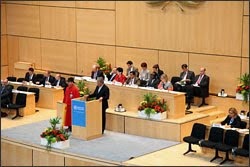
WHO/Jess HoffmanPRESS RELEASE: 'Sixty-third World Health Assembly unanimously adopts the WHO global Code of practice on the international recruitment of health personnel. Alliance members and partners applaud Member States. The Alliance 21/05/2010.

[Photo: WHO/Jess Hoffman. Dr Pierre François Unger, State Councillor of the Canton of Geneva, addresses delegates at the opening of the Sixty-third World Health Assembly.]

'Geneva, 21 May 2010 - In a historic move today, the Sixty-third World Health Assembly unanimously passed a resolution to adopt the voluntary WHO global Code of practice on the international recruitment of health personnel. With this step, the world's nations acknowledge the global dimension and complexities of the health workforce crisis and the interconnected nature of both the problems and the solutions.

'With this resolution, Member States commit themselves to the voluntary principles and practices for the ethical international recruitment of health personnel taking into account the responsibilities and rights of source and destination countries, other stakeholders, and those of the migrant health personnel themselves. The Code provides ethical principles applicable to the international recruitment of health personnel in a manner that strengthen the health systems of developing countries.

'A drafting committee was established on the first day of the Assembly and after three days of negotiations, stayed up till 4:30 am on Thursday, 20 May 2010 to seek consensus on a draft resolution that retained the principles and spirit of the Code while also representing a way forward for all countries.

'The draft was unanimously accepted at the tenth session of Committee A late evening on 20 May 2010 and brought long awaited joy and celebration to the many organizations and individuals, campaigners and professionals, institutions and Member States who had been working tirelessly since the last three years to see a meaningful and equitable resolution on the Code be adopted at the World Health Assembly.

'"The process was not always easy, but there was commitment from all Member States to see a resolution adopted. This helped to keep the process moving and the results are there to see" says Alliance Board member, Bjarne Garden, Assistant Director, Global Health and AIDS Department, NORAD, a member of the Norwegian delegation.

'"This brings to fruition the pioneering work seeded by the Alliance three years ago with the creation of the Health Worker Migration Initiative bringing together the Health Worker Migration Global Policy Advisory Council and WHO led team of technical experts. It is the result of the work of multiple stakeholders who have effectively rallied around together. The world is now a significant step closer to ensuring health workers are available and accessible to all", says Dr Mubashar Sheikh, Executive Director, Global Health Workforce Alliance.

'World Health Organization (WHO) has played a key role in coordinating the process. "The Code sets out a roadmap for implementation. Within 2 years WHO will provide guidance to countries on monitoring implementation of the Code, and then report to the Assembly on the progress against implementation. The Code is voluntary, but progress on implementation will be monitored and reviewed" explained Dr Manuel Dayrit, Director, WHO department of Human Resources for Health.

'Health personnel migration has been a clearly identified priority for the Alliance since its inception. During the First Global Forum on Human Resources for Health in March 2008, the Alliance endorsed the Kampala Declaration and Agenda for Global Action, which sparked broad interest in the creation of the Code.

'Progress on the code has been achieved as a result of consultations and discussions, particularly at all six WHO Regional Committees and national consultations, involving participation by a wide range of stakeholder groups. The UN ECOSOC meeting and the G8 Summit in July 2009, and the UN General Assembly in December 2009 had strongly supported and encouraged WHO to move forward in finalizing the draft code of practice. The 126th Session of the WHO Executive Board, January 2010, had discussed a revised draft of the Code and recommended that it be submitted to the 63rd World Health Assembly.

'At this momentous milestone, the Alliance and WHO call upon Member States and all its partners to reinforce its spirit of working together as they now gear up to implementing the code. The Alliance remains committed to facilitating the process and supporting sharing of information among Member States and all stakeholders.'

The Draft Resolution, dated 20 May 2010, is available here:
http://www.who.int/workforcealliance/knowledge/themes/migration/wha_A63_A_Confpaper_11.pdf

Key elements of the draft code (as described in The Lancet, 15 May) are:
  • Establishment of voluntary global standards for ethical international recruitment of health personnel, balancing rights and obligations of source states, destination states, and health personnel.
  • Promotion of coordination of national policies and international cooperation among states and their partners in health professions and civil society.
  • Recommendation that states strive to meet their domestic needs for health services with their own human resources through planning, education, and training for health workforce.
  • Recommendation that states ensure that international migration should have net positive effect on developing countries through technical assistance, support for health personnel training and retention, twinning of health facilities, and specialised technology and skills transfers.
  • Recommendation that states establish voluntary financial mechanisms to support efforts of developing countries to strengthen health systems.
  • Recommendation that states protect rights of migrant health workers through fair labour practices. In all terms of employment and conditions of work, migrant health personnel should enjoy same legal rights and responsibilities as domestically trained health workforce, without discrimination.
  • Recognition that health personnel have ethical responsibilities to cooperate with local authorities in interests of patients, health systems, and society.
  • Recommendation for national data collection and information exchange on health personnel migration, including establishment of national centre for information exchange, expansion and coordination of national research, and periodic reporting to WHO.
  • Promotion of compliance through periodic state reporting to WHA of measures taken to implement the code; and recommendation that WHA periodically reviews the code's implementation with input from non-governmental sources.
Allyn L Taylor & Lawrence O Gostin. International recruitment of health personnel. The Lancet, 375(9727)1673-1675, 15 May 2010
http://www.thelancet.com/journals/lancet/article/PIIS0140-6736%2810%2960596-X/fulltext?_eventId=login&&version=printerFriendly
(free access after free registration)


My source: HIFA2015 with photo addition

Saturday, May 22, 2010

Ensuring You Have Nursing Skills Through 2030 ...

In Computing 20 May 2010 Andrew Charlesworth (p.24-26) writes about a report from Gartner the IT industry advisory group warning of a gap in mainframe skills due to the imminent retirement of experienced IT staff. The report notes:
"Increased focus needs to be to be on the preservation of detailed and specialised expertise that goes well beyond basic knowledge."
Nursing faces its own challenges in terms of skill gaps and loss of skills due to retirement. In contrast to the mainframe IT market the skills needed is in the orchestration of basic nursing care.

This is an ironic state of affairs as there are many forces acting to deprofessionalise nursing. Demographic trends is one. This is happening amid decades of specialisation and the production of - profession establishing - models and theories of nursing (care). Some of these are, however, quite complex and removed from the rudiments and tenets of basic nursing care.

The real irony here though? Well, as the demographic wave washes over many nurses themselves, the care they may subsequently need and receive will - just like mainframe skills - be the harvest from seeds they have also cast, or are sowing right now.

Ensuring You Have Mainframe Skills Through 2020, Gartner, Mike Chuba, Research VP.

Monday, March 15, 2010

Prime Minister’s Commission on the Future of Nursing and Midwifery in England – 2010

Earlier in March The Prime Minister’s Commission on the Future of Nursing and Midwifery in England published its final report.

You can download the report in full.

Box 3.1.2 (on page 43) features key statistics on nursing and midwifery:
  • In 2009 there were nearly 595,000 RNs on the register residing in England, 77% of them registered in the adult nursing branch.
  • In 2009 there were over 31,000 RMs on the register residing in England.
  • Nine out of 10 of RNs in England are female.
  • There are disproportionate numbers of men in more senior nursing positions and certain specialties: a third of mental health nurses, for example, are male.
  • Nearly all RMs in England are female. There are 131 male midwives.
  • Well over half the RNs and RMs working in the NHS in England (57%) are aged between 35 and 54, with less than 3% under 25. Almost 70% of RNs and RMs on the NMC register in England are aged 40 and over.
Reporting on the Commission's report the RCN Bulletin (10 March) notes the need to encourage more men into the profession and people from black and ethnic minority groups. As the list above highlights, however - There are disproportionate numbers of men in more senior nursing positions and certain specialties: a third of mental health nurses, for example, are male.

From my early nurse education days (especially from mental health to general nursing) you had no choice, but be aware of gender and just w(h)ere you had landed. Upon my first encounter with Hodges' model, the model stood out in the list of theories and models of nursing.

It was not listed on the original nursing theory website.
(Hence, the initial website project)
The majority of models and theories were created by women and outside England.#

The future of nursing depends on successfully addressing* the numbers: totals, proportions, recruits, retirees*. ... We can use the numbers, quality, safety and I have to say - Hodges' model to help craft the creative and innovative messages needed. We really are in for a fascinating and exciting 20-30 years in nursing; here in the UK, EU and Internationally. There is much more in the Commission's report to reflect upon which will follow here. ...

http://cnm.independent.gov.uk/

* Note the use of 'addressing' not balancing - that's why this is also challenging.
# This is not a complaint, just an observation.


Additional link:

Sciences care domain: Nursing theory and models of care resources

Sunday, June 7, 2009

Smiley career choices

It is nice to use smileys in e-mails and something now we take for granted. It made me smile placing this one on the page...

It is quite something else though when your job involves helping to put real smiles back on real faces, or more importantly helping people find contentment in their heart. ...


Additional links:

Mental Health Nursing

60+ Social Workers

Social Work careers


Friday, May 1, 2009

NHS Talent Management 2 July 2009


Well done HSJ!

This event should be a packed house -


IMHO - of course....

There is so much latent talent out there!

Friday, November 28, 2008

The Gretta Foundation - Increasing the Global Nurseforce

I was asked recently if I could assist a nurse in Tanzania regards training in the UK. As ever things are not straight forward in terms of funding and opportunities for overseas students. Several UK university schools did kindly respond with information about the current situation. Not unrelated then, I noticed this announcement on the GANM (Global Alliance for Nursing and Midwifery) list:

I wanted to distribute the link to the Gretta Foundation to the GANM membership.

As you all know, one of the biggest requests that we get in the GANM are those that involve education. This includes not only requests for online continuing education, but also opportunities for nurses to obtain advanced nursing degrees without leaving their countries, their families and their communities.

Gretta StylesI came across this today on the web and I forward on to all of you. The Gretta Foundation (named after Gretta Styles) has - as its mission -
"Our mission is to increase the global “Nurseforce” by providing full nursing scholarships to impoverished persons living in disease-burdened nations.

Nursing scholarship recipients, or Gretta Scholars, attend in-country nursing programs. In repayment for the scholarship assistance, graduating scholars serve for a predetermined period of time in their country’s clinics and hospitals."
For more information, visit: http://grettafoundation.org/index.html

Visit the web site

The email is intended only for the recipients. The owners of the Knowledge Gateway cannot be held responsible for the contents of the email message.

My source: GANM - Global Alliance for Nursing and Midwifery list; images from Gretta Foundation.