In Drupal musings 12 I mentioned that the classification of nursing practice is not necessarily at the forefront of nursing's mind set against the turbulence and rush of clinical areas.* This is especially so at the moment as nurses on wards, clinics and community try to identify savings.
I am interested in classification in part as this is the raison d'être for the health career model; on a mental (cognitive) level, in practice and potentially in virtual representations of health care activities. For learners it is an extra to hold the bicycle saddle for those first turns of the pedals. Additionally, for those who have completed many rides and races (lifelong learners) they can reflect on how they got there, and plan for the next round.
As a conceptual framework then h2cm is, like classification, in the background. The model can help to compose, direct and conduct (c-d-c) nursing (health and social) care. Classification matters to ALL nurses because we need to know not only the c-d-c of nursing but the outcomes too.
If all the above is in the background, then together with classification the health career model can help differentiate nursing as a discipline and make nursing visible. We can only take heed of the adage "divide and conquer" by being able to differentiate nursing from other disciplinary contributions. Then perhaps we can truly identify and so define the facets of integrated, interprofessional and multidisciplinary care that must also be person-centred. As nurses and the team respond to the individual's trauma (assault, illness, chronic disease ...), they can also assure their combined values, which must be defined and articulated if there is to be a unified philosophy.
If the respective professions have not noticed (I am sure they have) 'professionalism' is itself under assault in terms of unique knowledge and skills, respect, power and status. To a degree this a good thing. It is also called 'progress': countering restrictive practices, improving service access and challenging institutionalised and state paternalism. Professionalism is accorded for reasons of accountability, education, responsibility, integrity and advocacy. Amid the public (mental) health disaster that we face - the professions - are needed more than ever and if the assault is taken too far ... ?
* Should you know of examples where classification IS at the forefront of nursing practice please let me know - h2cmng @ yahoo.co.uk.
Showing posts with label integrated. Show all posts
Showing posts with label integrated. Show all posts
Sunday, September 5, 2010
Saturday, September 4, 2010
Free event 29th September 2010 Promoting the collaboration of Age research
Dear Colleagues,
 We are pleased to announce a fantastic free event coming up on the 29th of September 2010 titled - "Promoting the collaboration of Age research"
The event is run by the UK Age Research Forum (UKARF) which is a strategic partnership between government, research councils and charities that aims to make a positive difference to the lives of older people through research.
The aims of the conference are:
Time: 9:30am — 4:00pm
Venue: The Royal College of Physicians
11 St Andrews Place
Regent’s Park, London NW1 4LE
How to register: fill in the form attached or register online at -
http://web.me.com/magic_bean/UKARF/registration.html
KT-EQUAL will have a stand at the conference so please register for the event and drop by and say hello!
If you want to know what we are up to, register for any of our future events, or download our monographs from previous events please visit our website www.equal.ac.uk
Best Wishes
Helen Haigh
KT-EQUAL Co-ordinator
University of Sheffield
My source: Sparc/KT-EQUAL network
We are pleased to announce a fantastic free event coming up on the 29th of September 2010 titled - "Promoting the collaboration of Age research"The event is run by the UK Age Research Forum (UKARF) which is a strategic partnership between government, research councils and charities that aims to make a positive difference to the lives of older people through research.
The aims of the conference are:
- To highlight the best of UK research funded by collaborative working of the UKARF member organisations
- To demonstrate the benefits of collaborative working in age research
- To inform about developments in age research in the UK
Time: 9:30am — 4:00pm
Venue: The Royal College of Physicians
11 St Andrews Place
Regent’s Park, London NW1 4LE
How to register: fill in the form attached or register online at -
http://web.me.com/magic_bean/UKARF/registration.html
KT-EQUAL will have a stand at the conference so please register for the event and drop by and say hello!
If you want to know what we are up to, register for any of our future events, or download our monographs from previous events please visit our website www.equal.ac.uk
Best Wishes
Helen Haigh
KT-EQUAL Co-ordinator
University of Sheffield
My source: Sparc/KT-EQUAL network

Friday, August 27, 2010
Drupal musings 12: Semantic Web, ICNP, Case studies and Care domains
Drupalcon 2010 Copenhagen is over for me. It's been a really useful week: awesome indeed. My head is dizzy with all the options, sources and resources to consider. I will contact the London Drupalcon group for 2011 with some suggestions regards beginners, networking and outreach.
Ever since setting off on the Drupal road, the semantic web has been a constant item of street furniture. In Szeged '08, Paris last year and this past week in Copenhagen the semantic web, RDF and terminologies have had a pivotal presence. I did not attend all the rdf / SW sessions but Wednesday's Semantic Terminologies was sit on the floor popular (even though at that point the program hit a bottleneck from 6 to 3 streams). Whatever the cause - I was there, late and my pivot ached (no padding!).
As a Drupal 7 prelude I'm creating a Drupal 6 site, a basic homepage for someone. The content for the latter is fixed - sorted. Apart from the pages for the archive, the new h2cm content involves me figuring out how to combine:
As for the list: #1 The health career model is straight forward really. Four care domains - get on with it! From there though it is quite a reach to encompass #2 & #3. My options appear to be:
I have followed the development of nursing terminologies for quite some time. The most striking thing to me is how removed they are from the day-to-night life on wards and other care encounter situations. With mental health as a Cinderella in terms of the politics and recognition of nursing service provision I am in effect professionally twice removed. For the vast majority of nurses on the ground and from where I work in community mental health the ICNP, SNOMED CT, Omaha and other schemes are rather esoteric things. They are there in the background, part of management and reporting 'function'. This is not to say that the above initiatives have few followers, or lacks experts in this field. Make no mistake nursing has its own geeks, nursing classification its experts!
The scope of ICNP makes it a great candidate (from the website) -
Diagnosis/outcome
Interventions
Individual 7 axes
Plus:
Perhaps as things improve economically, nursing classification will be revived and will allowed the time to fully mature? I recall in 2006 plans to explore mental health within SNOMED which unfortunately did not materialise. So, when I say mature, I mean like cheese in the holistic senses of the ingredients: nursing care concepts across contexts that also incorporate self-care, recovery, demographic trends ...; and the process across communities of practice (integrated care) through to academic and management applications - research / reporting.
In March 2010 plans were announced of plans to harmonize the efforts of the ICNP and SNOMED CT nursing:
http://www.ihtsdo.org/nc/about-ihtsdo/harmonization/icn/?sword_list[]=nursing
So, with a possible jumpstart - a sprint for my site this autumn in Manchester, UK and work afoot to make nursing classification matter on the 'ground' there is more to follow on several fronts. ... I remember a presentation Derek did in the 1990s about classification and making nursing visible - let's do it!
contact: h2cmng @ yahoo.co.uk
Ever since setting off on the Drupal road, the semantic web has been a constant item of street furniture. In Szeged '08, Paris last year and this past week in Copenhagen the semantic web, RDF and terminologies have had a pivotal presence. I did not attend all the rdf / SW sessions but Wednesday's Semantic Terminologies was sit on the floor popular (even though at that point the program hit a bottleneck from 6 to 3 streams). Whatever the cause - I was there, late and my pivot ached (no padding!).
As a Drupal 7 prelude I'm creating a Drupal 6 site, a basic homepage for someone. The content for the latter is fixed - sorted. Apart from the pages for the archive, the new h2cm content involves me figuring out how to combine:
- the health career model;
- nursing - in theory and practice;
- external sources and resources;
- and Drupal.
As for the list: #1 The health career model is straight forward really. Four care domains - get on with it! From there though it is quite a reach to encompass #2 & #3. My options appear to be:
- free tagging, auto tagging - let the users of the site decide;
- pre-define a data set, a terminology (classification) for the health career model;
- use an existing nursing classification / terminology scheme - perhaps a subset.
I have followed the development of nursing terminologies for quite some time. The most striking thing to me is how removed they are from the day-to-night life on wards and other care encounter situations. With mental health as a Cinderella in terms of the politics and recognition of nursing service provision I am in effect professionally twice removed. For the vast majority of nurses on the ground and from where I work in community mental health the ICNP, SNOMED CT, Omaha and other schemes are rather esoteric things. They are there in the background, part of management and reporting 'function'. This is not to say that the above initiatives have few followers, or lacks experts in this field. Make no mistake nursing has its own geeks, nursing classification its experts!
The scope of ICNP makes it a great candidate (from the website) -
Diagnosis/outcome
Interventions
Individual 7 axes
Plus:
- it's International;
- it's by nurses, for nurses;
- it has momentum (political and financial support);
- So it is credible, and research based.
Perhaps as things improve economically, nursing classification will be revived and will allowed the time to fully mature? I recall in 2006 plans to explore mental health within SNOMED which unfortunately did not materialise. So, when I say mature, I mean like cheese in the holistic senses of the ingredients: nursing care concepts across contexts that also incorporate self-care, recovery, demographic trends ...; and the process across communities of practice (integrated care) through to academic and management applications - research / reporting.
In March 2010 plans were announced of plans to harmonize the efforts of the ICNP and SNOMED CT nursing:
http://www.ihtsdo.org/nc/about-ihtsdo/harmonization/icn/?sword_list[]=nursing
So, with a possible jumpstart - a sprint for my site this autumn in Manchester, UK and work afoot to make nursing classification matter on the 'ground' there is more to follow on several fronts. ... I remember a presentation Derek did in the 1990s about classification and making nursing visible - let's do it!
contact: h2cmng @ yahoo.co.uk
Sunday, July 4, 2010
The cost of anholistic care
Being 'holistic' in care delivery can seem anachronistic, paying homage to new age thinking and practices. Paradoxically, being holistic in nursing can also mimic an admin exercise that amounts to ticking the boxes. So for Hodges' model - have you visited all the care domains?
Last month 23 June, 2010 The Guardian, Society Guardian featured The high cost of return:
- INTERPERSONAL care ✓
- POLITICAL care ✓
- PHYSICAL care ✓
- SOCIAL care ✓
- idealised care;
- standardised care;
- evidence of policy, targets;
- sign posting for the care pathway;
- an essential care aspiration that emphasizes the individual's strengths and resources.
Last month 23 June, 2010 The Guardian, Society Guardian featured The high cost of return:
Hospitals could lose up to £1.5bn of NHS funding a year because of the government's decision to penalise those where patients return within 30 days of being treated. That is the conclusion of research conducted by health analysts Dr Foster into the potential impact of the tough new policy. It warns that NHS trusts face large potential losses, the biggest could reach £28.7m, as a result of the new approach. In all, 146 acute, specialist and mental health trusts could lose out. Denis Campbell, p.3.Apparently -
Andrew Lansley wants to force the NHS to provide better care in hospitals and mental health establishments, to keep treating patients there until they are fit to leave and to work more closely with community-based healthcare professionals, such as GPs and district nurses, to ensure sick people receive more help with their convalescence after discharge and so are less likely to return to hospital. "Making hospitals responsible for a patient's ongoing care after discharge will create more joined-up working between hospitals and community services and may be supported by the developments in re-ablement and post-discharge support," he says.I hope in reading the above you have a sense of my frustration in that the health career model can encourage and support timely reflection that can help achieve holistic, integrated - coherent care.
If the model was shared
- a common resource -
across disciplines and available to patients and carers
then the potential benefits (and savings?) are even greater.
- a common resource -
across disciplines and available to patients and carers
then the potential benefits (and savings?) are even greater.
Saturday, April 10, 2010
Holistic interferometry
Since Galileo first pointed a telescope at the moon, the instrument has evolved with bigger lenses and mirrors. Despite additional advances in optics, physical constraints eventually prompted development in other directions. Rather than one optical or radio telescope, why not combine the inputs of several, tens, hundreds... ?
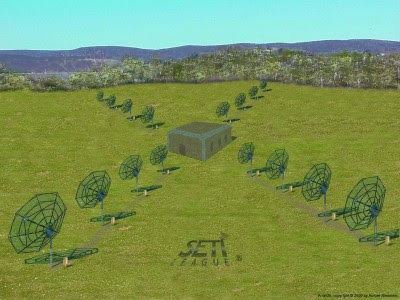
We desperately need holistic interferometry for the personal, social, community (urban, rural and nomadic), national and global health care challenges we face.
* Which includes much of the electromagnetic.
Links:
Interferometry: Space.com
Plateau de Bure Interferometer (PdBI)
Allen Telescope Array
SETI@home
Seti Inst.
LIGO, the Laser Interferometer Gravitational Wave Observatory
Image source: Seti League
http://www.setileague.org/array2k/array2kb.jpg

We desperately need holistic interferometry for the personal, social, community (urban, rural and nomadic), national and global health care challenges we face.
* Which includes much of the electromagnetic.
Links:
Interferometry: Space.com
Plateau de Bure Interferometer (PdBI)
Allen Telescope Array
SETI@home
Seti Inst.
LIGO, the Laser Interferometer Gravitational Wave Observatory
Image source: Seti League
http://www.setileague.org/array2k/array2kb.jpg
Thursday, April 8, 2010
International Journal of Integrated Care

Dear IJIC reader,
Recently PUBLISHED in the International Journal of Integrated Care
A Research and Theory paper:
An evaluation of SNOMED CT® in the domain of complex chronic conditions,
by Tara Sampalli, Michael Shepherd, Jack Duffy and Roy Fox
… It is the hypothesis of this work that showing the availability of multidisciplinary concepts for one complex condition can generate a similar expectation of available terms for other chronic conditions …
A policy paper:
Integrating care for people with mental illness: the Care Programme Approach in England and its implications for long-term conditions management,
by Nick Goodwin and Simon Lawton-Smith
… the lesson from the CPA experience suggests that there is potential for better care integration to be had in a strategy based on personalised care planning and investment in care co-ordination for people with chronic and sometimes complex needs …
And a book review:
Managing transition. Support for individuals at key point of change, edited
by Alison Petch and reviewed by AnneLoes van Staa
…This book is unique in its broad focus on different transitions in various contexts, and its exploration of the evidence for support given to people who risk getting ‘lost in transition’. This makes this publication highly interesting to readers of the International Journal of Integrated Care …
The IJIC journal is freely available at: http://www.ijic.org/
10th INTERNATIONAL INTEGRATED CARE CONFERENCE
“All together now: Exploring the Many Faces and Facets of Integrated Care”,
Tampere Finland, June 16-18, 2010.
“All together now: Exploring the Many Faces and Facets of Integrated Care”,
Tampere Finland, June 16-18, 2010.
The INIC Conference 2010 will make an effort to look at and evaluate the challenges and status quo of mutual many-faceted collaboration of integrated care from the point of view of benefits to patients, service users and carers. The annual conferences offer an ideal meeting place for the integrated care community to discuss recent developments and future challenges across systems and continents.
On the website you can find more information on the keynote speakers, the pre-conference and site-visits, the program of the conference and the parallel sessions.
Visit the conference website at: http://www.integratedcare.org for more information and registration.
Thanks for the continuing interest in our work.
Erika Manten
Managing editor IJIC
ijic at uu.nl
___________________________________________________
Erika Manten - Managing editor International Journal of Integrated Care,
http://www.ijic.org/ - IJIC Editorial office: Igitur, Utrecht Publishing &
Archiving Services, University Library Utrecht, P.O. Box 80124, 3508 TC
Utrecht, The Netherlands.
Wednesday, March 10, 2010
Walls, Lines, Dykes and Health Care

We are accustomed to defensive care and medicine.
Costs aside it seems the driving mantra (always served with a smile) is avoid risk at all cost; but we also recognise the need to balance risk in its negative and positive forms.
When it comes to thinking about care though we need to be open to new ideas, territories and opportunities and what being defensive means in practice and theory in the 21st century.
Additional links:
http://en.wikipedia.org/wiki/Offa%27s_Dyke
It is unlikely that the Dyke was constructed as a defensive earthwork. No army of the period could defend a 120 plus mile long earthwork. It is more likely that the Dyke was constructed as a political statement of power and intent.http://en.wikipedia.org/wiki/Great_Wall_of_China
Wednesday, November 18, 2009
Ageism: Four year old ideas and big pictures
Models of nursing are still alive and kicking on nurse education curricula. One day ;-) I will do that literature search and look at the numbers and dates of publication. It seems reasonable to assume that there are now fewer newborn and infant examples compared with the 70-90s. While internet time may be compressed there must be strange goings on in nursing academia if some students (apparently) only refer to sources within the past four years. The field is going to be very furrowed with so many wheels being brought to bear on theory and practice and then suddenly cast aside to rust (if mechanistic) or go rotten (if humanistic) or perhaps both (holistic). Wither a space for creativity and innovation that also supports sustainability, continuity, stability, integrity...? Are they mutually exclusive?
 If there is an over-four-year-can't-go-there! rule then logic suggests that a newly realised evidence-based method or tool has a limited life span for some students. This constant, iterative, critique of theory and practice IS crucial, but in terms of doing those things that depend on nurses weaving between subject disciplines and other professions where is the big picture? How old are your stories: the ones that really count?
If there is an over-four-year-can't-go-there! rule then logic suggests that a newly realised evidence-based method or tool has a limited life span for some students. This constant, iterative, critique of theory and practice IS crucial, but in terms of doing those things that depend on nurses weaving between subject disciplines and other professions where is the big picture? How old are your stories: the ones that really count?
Wednesday, February 25, 2009
Oh dear! I forgot to ask the nurse (doctor)....
Hodges' model introduction II:
The view from the other side of the fence
Have you ever been to see the doctor or nurse and shortly after leaving the surgery, or clinic you've remembered something? These days - very sadly - many people go to the doctor to seek help for their memory, but for others this is a fact of that frustrating mix of vital questions and issues to raise amid recognition that the time of nurses and doctors is very precious.
This post introduces a framework that can help people to prepare for a consultation and maintain a record of just where their care situation is up to. The framework in question is called Hodges' model. It is named after a retired Senior Lecturer called Brian Hodges who lives in Sheffield, England. Brian Hodges created the model to help nurses and community staff ensure the care they deliver is holistic. Holistic in this sense means covering all the essential aspects that contribute to health and well-being, so that includes physical, emotional and mental and even spiritual health.
If you need to go into hospital you do not want to be treated like a faulty machine. Of course, in an emergency those machine-like things we do like heart beat, respiration, temperature regulation are of central importance. Should you ever need emotional care for a severe mental health problem then you would also expect that your physical needs are taken fully into account. Amidst these aspects of care the health care team must also pay attention to culture, equality, diversity and access to services.
Although the model was developed in the 1980s its relevance and potential increases in all the time. This is because of the following:
* health care and medicine is increasingly complex;
* people may have long term and multiple chronic problems;
* education is essential to 21st century care management - as people are expected to 'self-care';
- people may also be managing their own care budget and so need information and 360 vision;
* policy makers stress the need for 'patient choice';
* high quality health and social care is very expensive;
* as people live longer and may have several relationships spanning cultures and belief systems the notion of a health career is the career.
Hodges' model builds on two basic facts of life (and death):
From your point of view and that of any health or social care professional your health is about you - an INDIVIDUAL.
Your health affects other people - most significantly your family. Rather than you being ill, you may of course be a carer having to look after a relative. Also affected are work colleagues, the wider community through to whole GROUPS of people.
We now talk about medicine, well-being, and health in terms of global health since the population of Earth is so tightly linked and interdependent.
In order to maintain health there is a need to diagnose and intervene - or assess, plan, intervene and evaluate. Here the model can also take into account ethnic and transcultural aspects of health. Diagnosis and intervention in Western medicine is frequently MECHANISTIC and this is balanced (remember that HOLISTIC part of the model) by the need for HUMANISTIC interventions. This is what we mean by 'bedside manner' and people being 'caring'. The ability to empathise with others and develop a therapeutic rapport after physical and emotional trauma is a great gift - that while often innate can also be learned and honed.
Once Brian Hodges had identified the following dimensions of care:
INDIVIDUAL - GROUP and HUMANISTIC - MECHANISTIC
he considered the types of knowledge that health and social care workers need to not only do their job safely, effeciently and effectively, but also help people to help themselves. This led to the FOUR CARE or KNOWLEDGE DOMAINS, each covers a key aspect of care:
 SCIENCES: e.g. anatomy, physiology,healing process, drugs, risk, diagnosis...
INTRAPERSONAL: e.g. mood, thinking, beliefs, communication, education, learning, coping...
SOCIOLOGY: e.g. relationships, roles, meaning, groups, resources
POLITICAL: e.g. choice, consent, autonomy, policy, legislation, finances
Students - young and mature - who decide to study health and social care can use the model to help them reflect on critical events in their training and learning. The model can help them gain some insights in completing essays and case studies integrating knowledge and experience. When you think about it: if it essential that care professionals are able to have an effective dialogue with patients and the public then they should also be capable of having an effective 'dialogue' with themselves.
Members of the public can also be taught the model to help them appreciate the factors involved in their care programs, solutions and ongoing management if required. Hopefully this brief explanation sheds some light on the model's mantra:
Hodges' model is no universal panacea it is just a tool; but while services stress the need for person-centered, integrated, value-for-money, high quality services ... built on respect, dignity, trust and choice - YOUR health career matters.
On the website's homepage there are four introductions based upon the care domains. Each one addresses a particular audience: learners (SCIENCES); patient (INTRAPERSONAL); carer (SOCIOLOGY) and policy maker / manager (POLITICAL). They all need updating (re-writing?!).
If you would like to contribute to this exercise please contact me through twitter or at h2cmng at yahoo.co.uk
The view from the other side of the fence
Have you ever been to see the doctor or nurse and shortly after leaving the surgery, or clinic you've remembered something? These days - very sadly - many people go to the doctor to seek help for their memory, but for others this is a fact of that frustrating mix of vital questions and issues to raise amid recognition that the time of nurses and doctors is very precious.
This post introduces a framework that can help people to prepare for a consultation and maintain a record of just where their care situation is up to. The framework in question is called Hodges' model. It is named after a retired Senior Lecturer called Brian Hodges who lives in Sheffield, England. Brian Hodges created the model to help nurses and community staff ensure the care they deliver is holistic. Holistic in this sense means covering all the essential aspects that contribute to health and well-being, so that includes physical, emotional and mental and even spiritual health.
If you need to go into hospital you do not want to be treated like a faulty machine. Of course, in an emergency those machine-like things we do like heart beat, respiration, temperature regulation are of central importance. Should you ever need emotional care for a severe mental health problem then you would also expect that your physical needs are taken fully into account. Amidst these aspects of care the health care team must also pay attention to culture, equality, diversity and access to services.
Although the model was developed in the 1980s its relevance and potential increases in all the time. This is because of the following:
* health care and medicine is increasingly complex;
* people may have long term and multiple chronic problems;
* education is essential to 21st century care management - as people are expected to 'self-care';
- people may also be managing their own care budget and so need information and 360 vision;
* policy makers stress the need for 'patient choice';
* high quality health and social care is very expensive;
* as people live longer and may have several relationships spanning cultures and belief systems the notion of a health career is the career.
Hodges' model builds on two basic facts of life (and death):
From your point of view and that of any health or social care professional your health is about you - an INDIVIDUAL.
Your health affects other people - most significantly your family. Rather than you being ill, you may of course be a carer having to look after a relative. Also affected are work colleagues, the wider community through to whole GROUPS of people.
We now talk about medicine, well-being, and health in terms of global health since the population of Earth is so tightly linked and interdependent.
In order to maintain health there is a need to diagnose and intervene - or assess, plan, intervene and evaluate. Here the model can also take into account ethnic and transcultural aspects of health. Diagnosis and intervention in Western medicine is frequently MECHANISTIC and this is balanced (remember that HOLISTIC part of the model) by the need for HUMANISTIC interventions. This is what we mean by 'bedside manner' and people being 'caring'. The ability to empathise with others and develop a therapeutic rapport after physical and emotional trauma is a great gift - that while often innate can also be learned and honed.
Once Brian Hodges had identified the following dimensions of care:
INDIVIDUAL - GROUP and HUMANISTIC - MECHANISTIC
he considered the types of knowledge that health and social care workers need to not only do their job safely, effeciently and effectively, but also help people to help themselves. This led to the FOUR CARE or KNOWLEDGE DOMAINS, each covers a key aspect of care:
 SCIENCES: e.g. anatomy, physiology,healing process, drugs, risk, diagnosis...
INTRAPERSONAL: e.g. mood, thinking, beliefs, communication, education, learning, coping...
SOCIOLOGY: e.g. relationships, roles, meaning, groups, resources
POLITICAL: e.g. choice, consent, autonomy, policy, legislation, finances
Students - young and mature - who decide to study health and social care can use the model to help them reflect on critical events in their training and learning. The model can help them gain some insights in completing essays and case studies integrating knowledge and experience. When you think about it: if it essential that care professionals are able to have an effective dialogue with patients and the public then they should also be capable of having an effective 'dialogue' with themselves.
Members of the public can also be taught the model to help them appreciate the factors involved in their care programs, solutions and ongoing management if required. Hopefully this brief explanation sheds some light on the model's mantra:
Hodges' Health Career (Care Domains) Model: h2cm
h2cm: help 2C more - help 2 listen - help 2 care
h2cm: help 2C more - help 2 listen - help 2 care
Hodges' model is no universal panacea it is just a tool; but while services stress the need for person-centered, integrated, value-for-money, high quality services ... built on respect, dignity, trust and choice - YOUR health career matters.
h2cm can help pull the many threads together....
<>
On the website's homepage there are four introductions based upon the care domains. Each one addresses a particular audience: learners (SCIENCES); patient (INTRAPERSONAL); carer (SOCIOLOGY) and policy maker / manager (POLITICAL). They all need updating (re-writing?!).
If you would like to contribute to this exercise please contact me through twitter or at h2cmng at yahoo.co.uk
Saturday, October 25, 2008
The Public, Patients and Carers in Hodges' model
The table below indicates some of the main concepts and concerns that
surround the PUBLIC, PATIENTS and CARERS agenda presented using the four care domains of Hodges' model:
surround the PUBLIC, PATIENTS and CARERS agenda presented using the four care domains of Hodges' model:
INTERPERSONAL : SCIENCES
SOCIOLOGY : POLITICAL
SOCIOLOGY : POLITICAL
| Well-being, mental (subjective) health, mood, hope, human spirit. Knowledge and understanding of condition. Literacies: 3Rs, ICT, social, visual, spiritual, health.... Diagnosis - prognosis. Psychological impact. Aware of info sources tolerance, personal choices & autonomy. Response to trauma, threat, loss. Belief systems. Coping strategies. Emotional memory Perception. 'Individual pain' Motivation. Responsibility Ability to work, personhood, dignity. | Physical (objective) health. Chronological - Pathological Age (of care subject, carers). 'Fitness'. Activity. Systems. SAFETY PROCESSES, structural flexibility. Pain thresholds. Measures (Pain genetics, scorecards). Systems, feedback, redesign, improvement. Complexity. Change. Research: Evidence-based care. NICE. Quantitative, Quality of Life, assessment, screening. Process redundancy. Decision making PEPIN: Professional Education Public Involvement UK Network Referral, care pathways, plans, time. Self-admin drugs. Expert patient. Health, care, eng. model(s) Ill-health - Health promotion Time for data collection. Curricula design, Courses, qualification. Standards vs Innovation Computer supported engagement* |
Carer - family understanding of condition, diagnosis-prognosis. Genetic implications (if any). Familial genetics pain. Sense making. Meaning. Social articulation of individual +ve & -ve experiences. Generational (role) inversion. Engagement and Social inclusion: work, social mobility, homelessness, stigma, poverty. Access to info and comms technology The Engaged E-patient Population Medical Sociology. Sick-role. PRACTICEEffects of culture 'meanings'. Dependency. Religion, fatalism. Leisure. Volunteering. Social capital / capacity. Collaborative care, concordance. Socio-cultural reach. Communications. Media. Dialogue. Qualitiative research. Social change attitudes. Shared definitions and meanings: 'engagement', 'health', 'wellness'... | POLICY, Nat. - U.N., FUNDING, GLOBAL ECONOMICS. Legislation: Section 11 of the Health and Social Care Act 2001. Nat. programs: Health For All. Health & Local Social Service Auths, 3rd & Independent sectors. Choice, Equity, Equality, Access, Advocacy Services. Consultation, engagement. (PALs) LINks. Definitions: engagement continua, datasets, intelligence / reporting. Service planning and development. 'Localisation' - Center. NHS Constitution Scalability of concept: Grp - Ind. Organisational empathy ('x.org' <-> public, patient 'rapport, involvement'). Economic cost of prolonged 'patiency'. 'Patient Lead'. Compliance. Political priorities, strategy, continuity. Policy half-life. Consolidation. Governance. Expenses. Specificity of roles, social exclusion. Wellness. Disability. Human Rights. Invalidity. Re-training. Health outcomes, assessment. (Lay) Representation. Champions. Black, Minority, Ethinic groups. 'Citizen-Patient'? DoH INVOLVE1 Involve2 Retirees. NHS: 'Open All Hours' Dedicated centres: e.g., NCI3 |
The focus above is UK, but can be readily revised to reflect other countries.
1. INVOLVE: Promoting public involvement in NHS, public health and social care research.
2. Involve: Promoting public and patient involvement in policy making and service design.
3. NHS Centre for Involvement.
Additional links:
Patients' use of the Internet for health related matters: a study of Internet usage in 2000 and 2006
Healthy Democracy: The future of involvement in health and social care, Edward Andersson, Jonathan Tritter and Richard Wilson (Editors).
Dept. of Health, Patient and Public Involvement
Engage, Northern Ireland.
The Local Government and Public Involvement in Health Act 2007
LINks: individuals and community groups who work together to improve local services.
Our health, our care, our say: a new direction for community services.
Patient Information Advisory Group (PIAG).
National Patient Safety Agency
The SOCIOLOGICAL links page includes 'Seven Ages', 'Public, Patients, & Carers'...
The INTRAPERSONAL links page includes 'Mental Health', 'Psychology', 'Therapies'...
The POLITICAL links page includes 'Policy', 'Citizenry'...
*Several informatics schools: community, urban, social, health, nursing, gender, e-gov...
Friday, September 12, 2008
Jobs, the Specifics of care and feeling Special
Recently in applying for jobs - left, right and further off-centre - the penny drop is long confirmed: it is not sufficient to include statements such as - "I have very good communication skills". Would-be employers need specifics.
A key quality of a 'good' nurse is that they can anticipate a patient's needs. Of course the whole care team are engaged in this activity. Foresight has always had a mystical quality to it, and no less today on wards, in clinics, community and occupational settings. ...
Anticipating care needs increases comfort, job satisfaction, saves time, money(?) and leaves people feeling better; even if they are far from 80-100%.
Good (effective) staff can use their knowledge, skills and experience plus that of colleagues AND the patient to head calamity off at the pass, whether in the form of emergency intervention, or a much needed bedpan and fan (you figure it out).
The key bit is what makes these special staff stand out. How they communicate this to the patient, the family and colleagues. This is why most staff and yet some staff in particular can make a world of difference.
Patients and the public
(as the two previous posts reveal)
need specifics too.
They do not just want to be "one of the crowd".
(as the two previous posts reveal)
need specifics too.
They do not just want to be "one of the crowd".
A key quality of a 'good' nurse is that they can anticipate a patient's needs. Of course the whole care team are engaged in this activity. Foresight has always had a mystical quality to it, and no less today on wards, in clinics, community and occupational settings. ...
Anticipating care needs increases comfort, job satisfaction, saves time, money(?) and leaves people feeling better; even if they are far from 80-100%.
Good (effective) staff can use their knowledge, skills and experience plus that of colleagues AND the patient to head calamity off at the pass, whether in the form of emergency intervention, or a much needed bedpan and fan (you figure it out).
The key bit is what makes these special staff stand out. How they communicate this to the patient, the family and colleagues. This is why most staff and yet some staff in particular can make a world of difference.
Even if the patient is a member of the crowd,
the quality of the care interactions make them feel unique,
cared for -
a person who matters.
the quality of the care interactions make them feel unique,
cared for -
a person who matters.
Wednesday, September 10, 2008
Don't waste energy - use a care plugin...
How often do policy makers refer to "joined-up care" while at the same time they strive for efficiency and effectiveness and the confusion that can arise there? As health and social care teams fall over themselves (efficiently) to deliver integrated and holistic care, they are also under pressure to attend to economy of effort. Resources are precious and must not be squandered. So often, despite the best efforts, the dots are not joined and the required rapid response falls short in terms of delivering interventions in the community that can prevent relapse and unnecessary admission.
 There is no magic formula for success.
The management of complex care is - complex! There will always be the exceptions that challenge the scintillatingly best qualified, evidence based savvy, fully integrated, IT literate, multidisciplinary, Olympic standard health and social care team.
Given how readily we are seduced by the words we use, there is more holistic value to be found.
It needs to be discovered though -
So don't waste energy -
join all the dots and think holistically!
There is no magic formula for success.The management of complex care is - complex! There will always be the exceptions that challenge the scintillatingly best qualified, evidence based savvy, fully integrated, IT literate, multidisciplinary, Olympic standard health and social care team.
Given how readily we are seduced by the words we use, there is more holistic value to be found.
It needs to be discovered though -
So don't waste energy -
join all the dots and think holistically!
Image source with many thanks: John Eric Hughes
Subscribe to:
Posts (Atom)